
Summary of TOSHIBA LAUNCHES VOLTAGE DRIVE PHOTORELAY WITH A TINY 2.9MM2 FOOTPRINT
Toshiba Electronics Europe has launched the TLP3407SR, a new voltage-driven photorelay designed to minimize equipment size and power consumption. This device features an ultra-compact S-VSON4T package with a 2.9 mm² footprint, representing a 27% reduction compared to previous models. It significantly lowers input power dissipation to 3.3 mW by reducing maximum LED current to 1 mA (or 0.2 mA for higher voltages), making it ideal for probe cards, automatic semiconductor test equipment (ATE), and semiconductor testers where space and energy efficiency are critical.
Parts used in the TLP3407SR Project:
- TLP3407SR voltage driven photorelay
- S-VSON4T package
- External resistor (for series connection)
- TLP3407SRH predecessor component (reference)
- VSONR4 existing package (reference)
Tiny device features lower input power to reduce equipment size and power consumption
Toshiba Electronics Europe (“Toshiba”) announces the availability of a new voltage driven photorelay with a tiny S-VSON4T package and reduced input power dissipation.
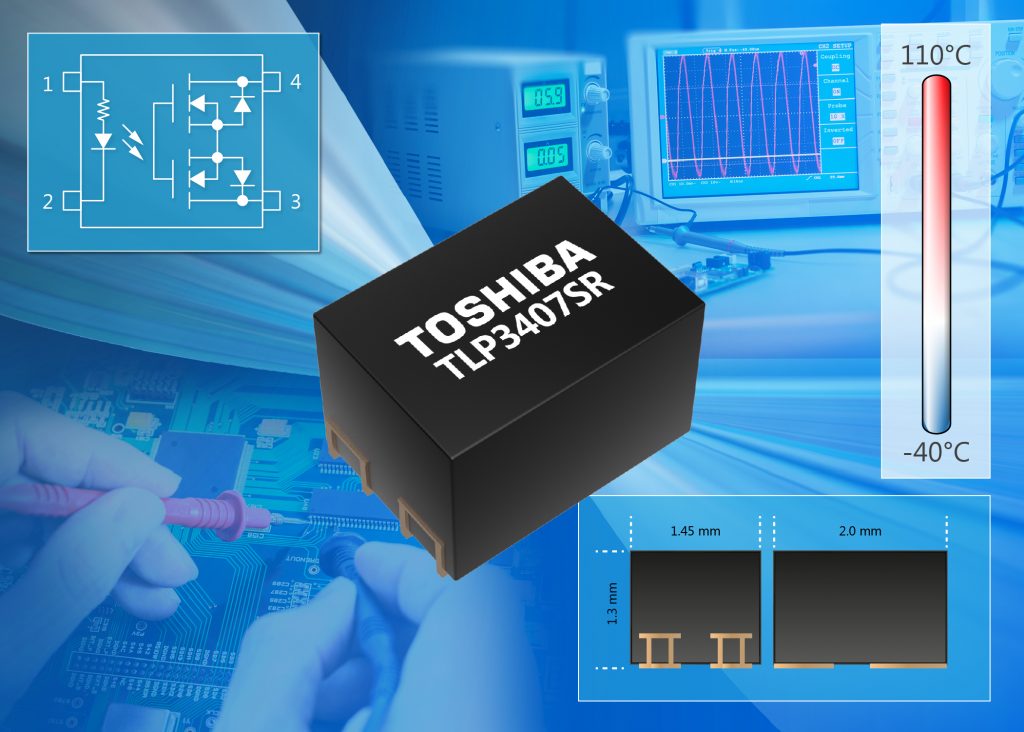
The new product, designated TLP3407SR, features a maximum LED current of just 1 mA at the input, which represents a reduction to approximately 33% of that of its predecessor, the TLP3407SRH. This allows the product to offer a maximum input power dissipation of 3.3 mW. For use with higher voltages of 5 V or more, the new device can be powered by adding an external resistor in series, allowing designers to implement a maximum trigger LED current of 0.2 mA. This expands the range of permissible input voltages, simplifying the task of circuit design.
With the reduced input power dissipation, the new voltage drive photorelay is suitable for reducing the power consumption of a wide variety of equipment including probe cards, automatic semiconductor test equipment (ATE), semiconductor testers, and other similar applications.
The TLP3407SR is housed in a tiny S-VSON4T package that features a mounting area / footprint of just 2.9 mm2 – a reduction of around 27% when compared to the existing VSONR4 package. As a result, this new product can help reduce the size of end products or increase the number of photorelays that can be mounted in a fixed space.
Read more: TOSHIBA LAUNCHES VOLTAGE DRIVE PHOTORELAY WITH A TINY 2.9MM2 FOOTPRINT
-
What is the maximum LED current of the TLP3407SR?
The maximum LED current is just 1 mA at the input. -
How much has the input power dissipation been reduced?
The maximum input power dissipation is 3.3 mW, which is approximately 33% of its predecessor. -
Can the device be powered by voltages of 5 V or more?
Yes, designers can add an external resistor in series to implement a maximum trigger LED current of 0.2 mA. -
What is the mounting area of the S-VSON4T package?
The mounting area or footprint is just 2.9 mm². -
How does the new package size compare to the VSONR4?
The new package offers a reduction of around 27% compared to the existing VSONR4 package. -
What applications is this photorelay suitable for?
It is suitable for probe cards, automatic semiconductor test equipment (ATE), and semiconductor testers. -
Does adding an external resistor simplify circuit design?
Yes, adding an external resistor expands the range of permissible input voltages and simplifies circuit design.
