
Summary of THIS FORCE CONTROLLED ROBOT GRIPPER IS LESS LIKELY TO BREAK STUFF
This article details a DIY force-controlled robotic gripper designed by James Bruton to safely handle delicate objects and interact with humans. The 3D-printed gripper uses bungee cords for retraction and servos with springs for extension. By measuring the difference between servo position and finger position via flex sensors, an Arduino Uno calculates applied force to prevent damage. While the design has minor inconsistencies in force measurement, it serves as a solid proof of concept available on GitHub.
Parts used in the Force Controlled Robot Gripper:
- 3D printed fingers (two joints each)
- Bungee cord
- Servo motors
- Springs
- Resistive flex sensors
- Arduino Uno
While robotic arms can handle a wide variety of tasks, the specific job at hand will have a major influence on the type of end effector used. For sorting ferromagnetic parts an electromagnet might be enough, while for more accurate location a mechanical gripper could be employed. If you’re working with particularly delicate objects or in concert with human beings, it may be desired to have a force controlled gripper to avoid damage. [James Bruton] has been whipping up a design of his own for just this purpose.
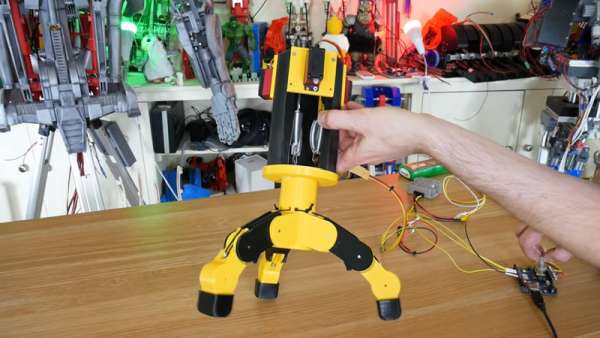
The basic gripper is 3D printed, with 3 fingers consisting of two joints each. Retraction of each finger is courtesy of bungee cord, while extension is via a servo attached to the finger through a spring. The position of each finger is measured with a resistive flex sensor. An Arduino Uno is employed to run the servos and read the attached sensors.
As force is applied by the servo, the spring begins to stretch. This leads to a greater difference between the servo position and the finger position as the applied force increases. By calculating this difference, it’s possible to determine the force applied by the fingers. This can then be used to limit the applied force of the gripper, to avoid breaking delicate objects or crushing soft, fleshy humans.
Being aware of the forces applied in mechanical settings can be key to getting good results. We’ve even seen arbor presses modified for just such a purpose. Video after the break.
Source: THIS FORCE CONTROLLED ROBOT GRIPPER IS LESS LIKELY TO BREAK STUFF
- What is the primary purpose of this gripper?
To avoid damage when handling delicate objects or interacting with human beings. - How does the gripper extend its fingers?
Extension is achieved via a servo attached to the finger through a spring. - How is the applied force determined?
The system calculates the difference between the servo position and the finger position. - Can this gripper be used to crush soft fleshy humans?
No, the force calculation allows the system to limit applied force to avoid crushing. - What component measures the position of each finger?
A resistive flex sensor is used to measure the position of each finger. - Does the force required to move the fingers remain consistent?
No, the force required is inconsistent along their travel which interferes with accurate measurement. - Where can users find the project files?
The files are available on Github for those who wish to tinker at home. - Is this design considered a final product?
It is described as a solid proof of concept and a good base for further revisions.
