
Summary of THE URU KEY, A BIOMETRIC FIDO2 AUTHENTICATOR FOR SAFE WEB NAVIGATION
The article details the development of "URU Auth," a custom FIDO2 WebAuthN authenticator by engineer Andrew Ovcharov. Designed to replace passwords with biometrics, this standalone device uses fingerprint scanning for secure web login. The project has successfully progressed from concept to a functional prototype where all components operate together, allowing users to authenticate via a small, wireless key rather than mobile phones or traditional passwords.
Parts used in the URU Auth:
- ESP32 Pico D4 microcontroller
- GROW R300 fingerprint scanner
- LEDs
- Connectors for programming and user feedback
- ATECC508a security chip
Since the internet remains quite vulnerable to security breaches, new measures have been taken to ensure that users are able to safely interact and navigate it in no time. Earlier last year, a new security model called the FIDO2 WebAuthn (Web Authentication) that helps to eliminate all forms of password theft and replay attacks was developed by the big tech companies and accepted for recommendation by the W3C Consortium. The FIDO2 WebAuthNtechnology which has much higher security than passwords was built to help users log in to their online accounts with their mobile phone, biometrics or FIDO security keys instead of having to always remember the many passwords that they have used for different sites.
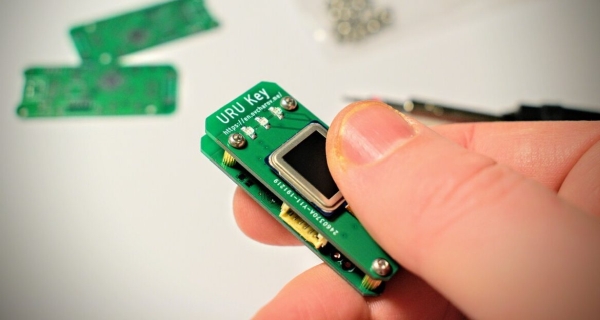
Taking it further, Electrical Engineer Andrew Ovcharov, last summer started working on developing his own FIDO2 Authenticator, the “URU Auth” derived from the abbreviation “You Are You”.
The URU key, about the size of a small flash drive, is a custom standalone wireless biometric FIDO2 WebAuthN Authenticator which uses a fingerprint scanner for authentication on WebAuthN-enabled websites. Instead of having to use mobile devices, users can power their URU key, scan a registered fingerprint and interact easily with WebAuthN web applications.
Ovcharov has been working on the URU key for about six months now and the project has successfully gone through the major developmental stages.
I have built a prototype board for the authenticator device, the fingerprint scanner was connected and the fingerprint image was acquired. The security chip was connected and communicated. Now all the small pieces work together as one device and the device starts to get a shape. I can hold it in my hand, I can confirm the authentication request and it makes me absolutely happy how it goes”, says the engineer.
The URU key, for now, features an ESP32 Pico D4 microcontroller for the wireless transfer of data, the GROW R300 fingerprint scanner for registering fingerprints, a few LEDs, connectors for programming and user feedback, and the ATECC508a security chip which implements the FIDO2 WebAuthN.
Read more: THE URU KEY, A BIOMETRIC FIDO2 AUTHENTICATOR FOR SAFE WEB NAVIGATION
- What is the purpose of the URU Auth device?
The device is a custom standalone wireless biometric FIDO2 WebAuthN Authenticator designed to help users log in securely using fingerprints instead of passwords. - How does the URU key enable authentication on websites?
Users power the key, scan a registered fingerprint, and interact easily with WebAuthN-enabled web applications without needing mobile devices. - Which microcontroller powers the wireless data transfer in the URU key?
The ESP32 Pico D4 microcontroller is used for the wireless transfer of data. - What component is responsible for registering fingerprints in the project?
The GROW R300 fingerprint scanner is used for registering fingerprints. - Does the ATECC508a chip support FIDO2 WebAuthN?
Yes, the ATECC508a security chip implements the FIDO2 WebAuthN standard. - Can the URU key function as a standalone device?
Yes, it is described as a custom standalone wireless biometric authenticator that does not require a mobile phone. - What role do the LEDs play in the URU key design?
The LEDs provide user feedback within the device. - Is the URU Auth project based on existing technology standards?
Yes, it utilizes the FIDO2 WebAuthN technology developed by big tech companies and accepted by the W3C Consortium.
