
Summary of TESLA MODEL S GETS BOOST WITH JET ENGINE UPGRADE
This article details [Warped Perception]'s project to enhance a Tesla Model S P85D by adding three jet turbines. The build involved extensive fabrication of over 200 parts, including a custom control panel with unique 3D-printed lettering techniques and an Arduino-based electronic system installed in the trunk. Testing revealed that while electric-only acceleration was 4.38 seconds, activating the jets reduced the 0-60 MPH time to 3.32 seconds.
Parts used in the Tesla Model S Jet Upgrade:
- Three jet turbines
- Tesla Model S P85D vehicle
- Control panel
- 3D printed lettering materials
- Plastic sheet
- Glue
- Clear coat
- Control electronics
- Wiring
- Three Arduinos
- Engine brackets
Tesla is well known for making cars that can accelerate quickly, but there’s always room for improvement. [Warped Perception] decided that his Tesla Model S P85D needed that little bit of extra oomph (despite the 0-60 MPH or 0-97 km/h time of 3.1 seconds), so he did what any sensible person would: add three jet turbines to the back of his car.
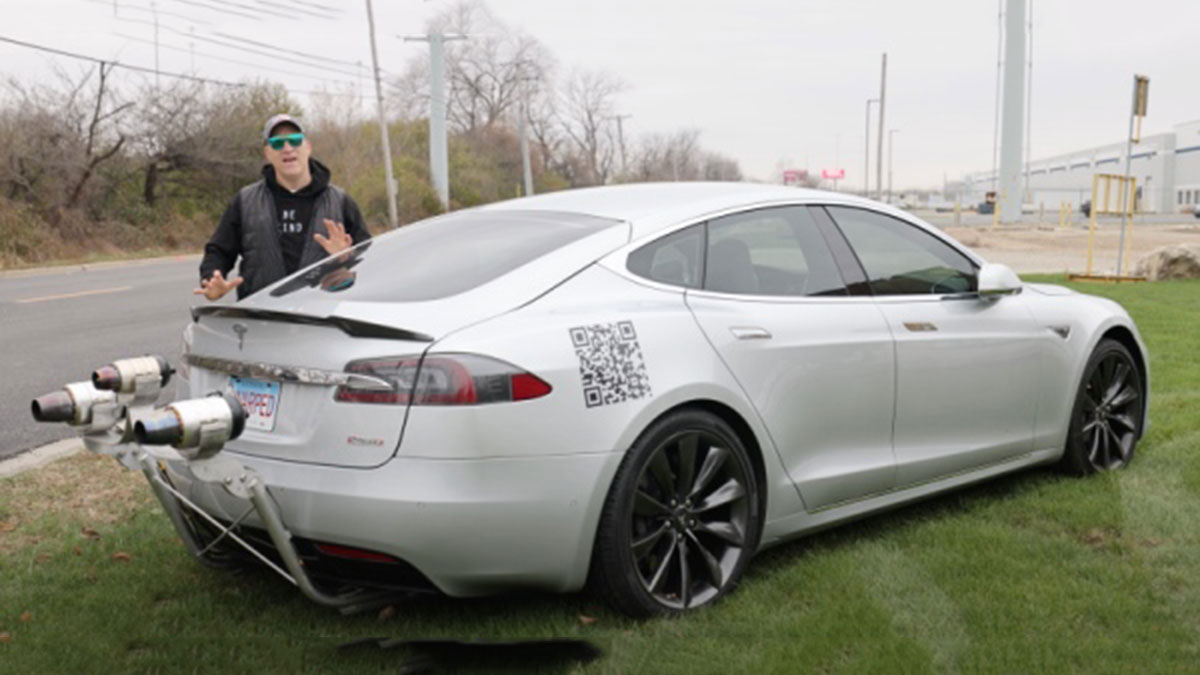
The best part of this particular build is the engineering and fabrication that made this happen. With over 200 pieces and almost all personally fabricated, this is a whirlwind of a build. The control panel is first, and there’s a particularly clever technique of 3D printing the lettering directly onto the control panel for the flat stuff. Then for the pieces with angles that would prevent the head from moving freely, he printed onto a plastic sheet in reverse, applied glue, then stuck the letters to the plate as a sheet. A top layer of clear coat ensures the letters won’t come off later.
He installed the control electronics in the trunk with wiring strung from the car’s front to the rear. Three Arduinos serve as controllers for the jets. Afterward, came the bracket to hold the engines and attach it to the car’s underside. Unfortunately, supplies were a little hard to come by, so he had to make do with what was on hand. As a result it didn’t come out as strong as he would have hoped, but it’s still pretty impressive.
[Warped Perception] does a few tests before taking it out on the road. Then, he shifted the car into neutral and could drive the car solely on jet power, which was one of his goals. While we don’t love the idea of testing a jet engine on public roads, it certainly would discourage tailgaters.
Next, he finds a quieter road and does some speed tests. Unfortunately, it was drizzling, and the pavement was damp, putting a damper on his 0-60 standing times. Electric-only he gets 4.38 seconds, and turning on the jets plus electric shaves that down to 3.32 seconds. Overall, an incredible build that’s sure to draw a few curious glances whenever you’re out on the town.
If you’re looking to upgrade your Tesla, perhaps instead of jet engines, you might opt for a robot to plug it in for you?
Source: TESLA MODEL S GETS BOOST WITH JET ENGINE UPGRADE
- How many jet turbines were added to the car?
Three jet turbines were added to the back of the Tesla. - What technique was used for the flat control panel lettering?
The creator 3D printed the lettering directly onto the control panel. - How does the angled lettering method work?
Letters are printed in reverse on a plastic sheet, glued as a sheet, and covered with clear coat. - What controllers manage the jet engines?
Three Arduinos serve as the controllers for the jets. - Where is the control electronics system installed?
The control electronics are installed in the trunk with wiring strung from front to rear. - Can the car drive solely on jet power?
Yes, the creator shifted the car into neutral and drove it solely on jet power. - What was the 0-60 time using only electric power?
The electric-only 0-60 time recorded was 4.38 seconds. - What was the 0-60 time with the jets turned on?
Turning on the jets plus electric shaved the time down to 3.32 seconds.
