
Summary of Teardown and experiments with a Doppler microwave transceiver
This article details the teardown of a Microsemi C900502 10.525 GHz X-band Doppler radar motion sensor. The device features a sturdy metal casing with integrated patch antennas on the PCB. Internally, it uses a simple design with only five discrete components, including an FET oscillator and a dielectric resonator for frequency stability. The circuit is divided into oscillator and mixer compartments to reduce leakage. It requires just three connections: +5V, ground, and IF output, and includes a frequency adjustment hole.
Parts used in the Microsemi C900502 Teardown:
- Microsemi C900502 10.525 GHz X-band Doppler radar motion sensor
- Sturdy metal casing
- PCB with etched patch antennas
- RF absorbing strips
- FET (Field-Effect Transistor)
- Dielectric resonator
- Distributed element filters
- Radial stubs
- Barium titanate material
I got a couple of Microsemi’s C900502 10.525 GHz X-band Doppler radar motion sensors a while ago. This batch was made in UK and had “UK patents 2243495 and/or 2253108 apply” printed on the case. I have seen a teardown of an HB100 Doppler radar module before and was wondering if I this one is any different inside.
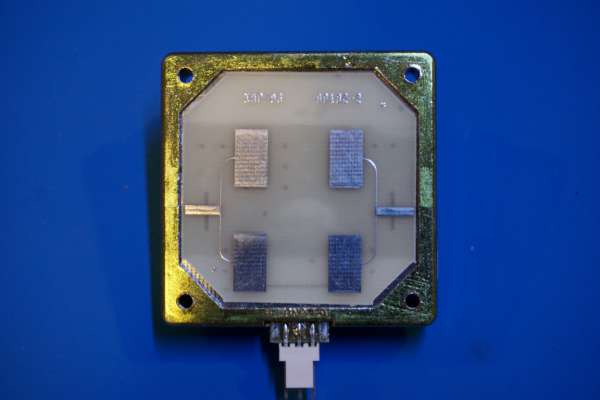
The C900502 transceiver has a very sturdy metal casing. It is measured at roughly 5cm by 5cm by 1cm. The transmitter and receiver antennas are patch antennas etched directly onto the PCB as you can see from the picture below:
On the back side you can see the patent number stamped onto the casing. There is an adjustment hole underneath the model number sticker. Using a screw driver, you can make fine adjustments of the transmitted frequency. Using this module is simple and only three connections are required: +5V, ground, and IF output.
Here is a picture of the back shielding removed. The shielding is divided into two compartments, one for the oscillator and the other houses the mixer. You can see some RF absorbing strips inside the oscillator compartment, this is to reduce the oscillator leakage into the mixer.
And here is a picture of the circuit board. It is surprisingly elegant, only 5 discrete components (two active components and three passive components) are used. The board layout is strikingly similar to that of HB100. Perhaps HB100 is based on the same patents?
Here is a closeup of the oscillator portion. The oscillator consists of a single FET. The brown cylindrical component is a dielectric resonator. Note that it is not physically connected to any other components. The coupling is achieved strictly via the electromagnetic fields outside the cylindrical boundary of the dielectric resonator. The resonant frequency (TE01n mode) of the dielectric resonator can be calculated as:

 r
r aL+3
aL+3 45
45
where the relative permittivity of the dielectric material is usually between 30 and 50. Barium titanate (BaTiO3) is a common material used for the dielectric resonator.
You can also see many distributed element filters on the PCB. Here you can see two radial stubs.
Read more: Teardown and experiments with a Doppler microwave transceiver
- What are the dimensions of the C900502 module?
The module measures roughly 5cm by 5cm by 1cm. - How many connections are required to use this module?
Only three connections are required: +5V, ground, and IF output. - Can the transmitted frequency be adjusted?
Yes, fine adjustments can be made using a screwdriver through an adjustment hole underneath the model number sticker. - How many discrete components are on the circuit board?
The board uses only five discrete components, consisting of two active components and three passive components. - What material is commonly used for the dielectric resonator?
Barium titanate is a common material used for the dielectric resonator. - How is coupling achieved for the dielectric resonator?
Coupling is achieved strictly via electromagnetic fields outside the cylindrical boundary of the dielectric resonator. - Does the internal layout resemble the HB100 module?
Yes, the board layout is strikingly similar to that of the HB100. - What is the purpose of the RF absorbing strips inside the oscillator compartment?
The strips are used to reduce oscillator leakage into the mixer.
