
Summary of TALKING WASHER IS A CLEAN SOLUTION FOR THE VISUALLY IMPAIRED
This article describes a DIY project by [Wingletang] to assist his visually impaired wife with a modern washing machine featuring LED-only cycle indicators. The solution, named SOAP (Speech Output Announcing Programmes), uses Light Dependent Resistors (LDRs) to detect lit LEDs and an Arduino clone to trigger audio announcements via a Velleman KA02 shield. The system is non-invasive, using recycled foam and styrene for the enclosure, effectively solving the tactile control issue without modifying the appliance itself.
Parts used in the SOAP Project:
- Light Dependent Resistors (LDRs)
- Recycled mouse pad foam
- Black styrene
- Arduino clone
- Velleman KA02 audio shield
- Project box
- Adhesive rubber feet (attempted earlier)
Have you shopped for an appliance lately? They’re all LEDs, LEDs everywhere. You might say that manufacturers are out of touch with the utility of tactile controls. [Wingletang]’s fancy new washing machine is cut from this modern cloth. While it does have a nice big knob for selecting cycles, the only indication of your selection is an LED. This isn’t an issue for [Wingletang], but it’s a showstopper for his visually impaired wife.
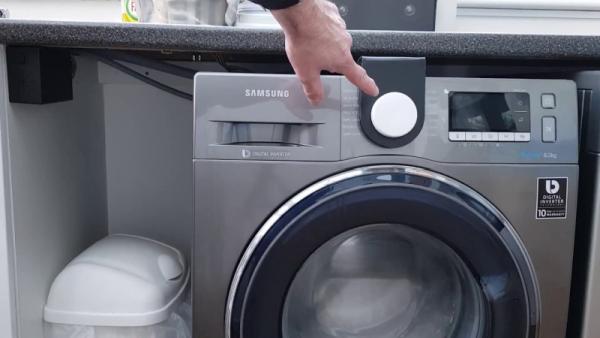
They tried to make tactile signposts for her most-used cycles with those adhesive rubber feet you use to keep cabinet doors quiet. But between the machine’s 14(!) different wash cycles and the endlessly-rotating selector knob, the tactile map idea was a wash. It was time to make the machine talk.
For his very first microcontroller project, [Wingletang] designed a completely non-invasive and totally awesome solution to this problem. He’s using LDRs arranged in a ring to detect which LED is lit. Recycled mouse pad foam and black styrene keep ambient light from creating false positives, and double as enclosure for the sensor and support boards. As [Mrs. Wingletang] cycles through with the knob, an Arduino clone mounted in a nearby project box determines which program is selected, and a Velleman KA02 audio shield plays a recorded clip of [Wingletang] announcing the cycle number and description.
The system, dubbed SOAP (Speech Output Announcing Programmes), has been a great help to [Mrs. Wingletang] for about the last year. Watch her take it for a spin after the break, and stick around for SOAP’s origin story and walk-through videos.
It’s baffling that so few washers and dryers let you know when they’re finished. Don’t waste your time checking over and over again—Laundry Spy waits for the vibrations to end and sends you a text.
Source: TALKING WASHER IS A CLEAN SOLUTION FOR THE VISUALLY IMPAIRED
- What problem does the SOAP project solve?
The project helps a visually impaired user identify washing cycles on a machine that only displays selections via LEDs. - How does the system detect which cycle is selected?
LDRs arranged in a ring detect which specific LED on the washing machine is currently lit. - What prevents false readings from ambient light?
Recycled mouse pad foam and black styrene are used to block ambient light and enclose the sensors. - Which microcontroller is used in the design?
An Arduino clone mounted inside a nearby project box determines the selected program. - How does the system announce the cycle to the user?
A Velleman KA02 audio shield plays a recorded clip announcing the cycle number and description. - Is the modification invasive to the washing machine?
No, the system is designed as a completely non-invasive solution that attaches externally. - What was the initial failed attempt to help the user?
The creators tried using adhesive rubber feet as tactile signposts but abandoned it due to the 14 different cycles and rotating knob.
