
Summary of STTS22H – LOW-VOLTAGE, ULTRA-LOW-POWER, 0.5 °C ACCURACY I2C/SMBUS 3.0 TEMPERATURE SENSOR
The STTS22H is an ultra-low-power, factory-calibrated digital temperature sensor in a 2 x 2 x 0.50 mm 6-lead UDFN package with exposed pad. It integrates a band-gap sensor, ADC, signal processing, and I²C/SMBus 3.0 interface, offering high accuracy (±0.5 °C from −10 °C to +60 °C), 16-bit output, one-shot mode, programmable thresholds with ALERT, and ultra-low current consumption over −40 °C to +125 °C.
Parts used in the STTS22H Project:
- STTS22H temperature sensor ASIC
- 2 x 2 x 0.50 mm 6-lead UDFN package with exposed pad
- I²C/SMBus 3.0 interface (serial communication protocol)
- Power supply (1.5 to 3.6 V)
- Interrupt/ALERT pin with programmable threshold circuitry
- Band-gap temperature sensing element
- On-chip A/D converter
- On-chip signal processing logic
The STTS22H is an ultra-low-power, high accuracy, digital temperature sensor offering high performance over the entire operating temperature range.
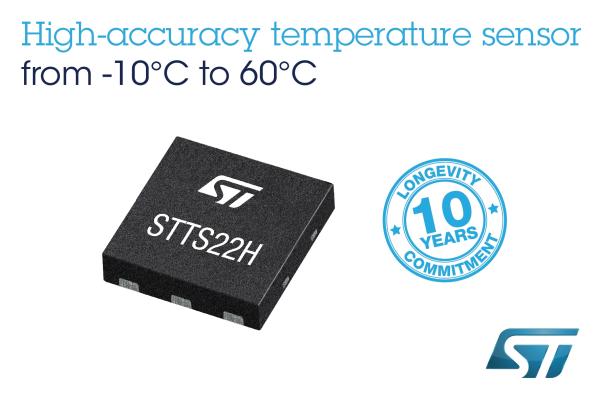
The STTS22H is a band gap temperature sensor coupled with an A/D converter, signal processing logic and an I²C/SMBus 3.0 interface all in a single ASIC.
This sensor is housed in a small 2 x 2 x 0.50 mm 6-lead UDFN package with exposed pad down for a better temperature match with the surrounding environment.
The STTS22H is factory calibrated and requires no additional calibration efforts on the customer side.
Features
- Key features
- Integrated high-accuracy temperature sensor
- Factory calibrated
- One-shot mode for power saving
- Electrical specifications
- Supply voltage: 1.5 to 3.6 V
- I²C, SMBus 3.0 with ALERT (ARA) support
- Programmable thresholds with interrupt pin
- Supports up to 1 MHz serial clock
- Up to 2 I²C/SMBus slave addresses
- Ultra-low current: 1.75 µA in one-shot mode
- Sensing specifications
- Operating temperature -40 °C to +125 °C
- Temperature accuracy (max.): ± 0.5 °C (-10 °C to +60 °C)
- 16-bit temperature data output
Read more: STTS22H – LOW-VOLTAGE, ULTRA-LOW-POWER, 0.5 °C ACCURACY I2C/SMBUS 3.0 TEMPERATURE SENSOR
- What is the operating temperature range of the STTS22H?
The operating temperature range is -40 °C to +125 °C. - How accurate is the STTS22H?
Temperature accuracy is ±0.5 °C from -10 °C to +60 °C. - What supply voltage does the STTS22H require?
Supply voltage range is 1.5 to 3.6 V. - Does the STTS22H support I²C communication?
Yes, it supports I²C and SMBus 3.0 with ALERT (ARA) support. - Can the STTS22H operate in a low-power mode?
Yes, it has a one-shot mode for power saving and ultra-low current usage (1.75 µA in one-shot mode). - What data resolution does the STTS22H provide?
It provides 16-bit temperature data output. - Does the STTS22H require calibration by the user?
No, the STTS22H is factory calibrated and requires no additional customer calibration. - What package is the STTS22H supplied in?
It is supplied in a 2 x 2 x 0.50 mm 6-lead UDFN package with exposed pad down. - Does the STTS22H provide interrupt or threshold features?
Yes, it has programmable thresholds with an interrupt (ALERT) pin.
