
Summary of Standalone Arduino / ATMega chip on breadboard
Summary: This Instructable guides beginners to remove a programmed ATmega chip from an Arduino Duemilanove and run it standalone on a custom circuit or breadboard. The author collated online advice into a single, easy-to-follow procedure, highlights adding decoupling capacitors near power for stability, and welcomes feedback while referencing further resources.
Parts used in the Standalone Arduino / ATMega chip on breadboard:
- Arduino Duemilanove (for initial programming)
- ATmega microcontroller (the programmed chip)
- Breadboard
- Power supply (5V)
- 10uF capacitor (power decoupling)
- 100nF capacitors (power decoupling)
- LED (for blink test)
- Resistor for LED
- Jumper wires
If you’re like me, after I got my Arduino and performed a final programming on my first chip, I wanted to pull it off my Arduino Duemilanove and put it on my own circuit. This would also free up my Arduino for future projects.
The problem was that I’m such an electronics newbie that I didn’t know where to start. After reading through many web pages and forums, I was able to put together this Instructable.
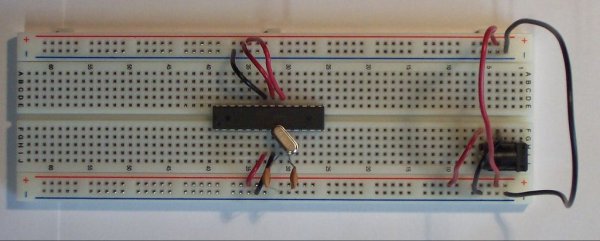
I wanted to have the information I learned all in one place, and easy to follow.
Comments and suggestions are welcome and appreciated as I’m still trying to learn all this stuff.
Edit:
Fellow Instructable member, Janw mentioned to me that it’s always a good idea to add a capacitor or 2 near your power. He mentioned using a couple of 100nF capacitors should work. I’m very grateful he pointed this out to me, because my first production circuit that I’m building upon this circuit, was having a little bit of strange behavior. So I hooked up one 10uF capacitor near my power, and it started behaving correctly! I don’t know why it didn’t affect my ‘blinking LED’ test, but I do know that I’m grateful for Janw for pointing this out to me. Thanks Janw.
Edit2:
Building upon the previous edit, I wanted to mention that Instructable member, kz1o brought out some more information regarding the capacitors. Please see his comment below, dated February 14th, 2010 @ 10:52 am.
For more detail: Standalone Arduino / ATMega chip on breadboard
- Can I pull my programmed chip off the Arduino and run it on my own circuit?
Yes; after programming the ATmega on the Arduino Duemilanove you can remove it and run it on your own circuit or breadboard. - What do I need to run the ATmega standalone?
You need the programmed ATmega chip, a breadboard, a 5V power supply, decoupling capacitors, and wiring plus any test components like an LED and resistor. - Do I need capacitors when building the standalone circuit?
Yes; the author and commenters recommend adding decoupling capacitors, such as 100nF and a 10uF near power, to prevent strange behavior. - Will the blinking LED test reveal power stability issues?
Not always; the author noted the blinking LED test did not show issues, but adding a 10uF capacitor fixed strange behavior in a later production circuit. - Is this guide suitable for electronics beginners?
Yes; the Instructable consolidates information into an easy-to-follow guide specifically aimed at newbies. - Can this free up my Arduino for other projects?
Yes; removing the programmed ATmega from the Arduino allows you to reuse the Arduino board for new projects. - Where can I find more detailed information?
The author references a more detailed resource titled Standalone Arduino / ATMega chip on breadboard for additional information.
