
Summary of Staircase Meets Piano
In late 2014, a student club built the Staircase Piano, an interactive musical instrument triggered by footsteps. Initially using an Arduino for sound generation via pulse width modulation, the team switched to a Raspberry Pi to play digital sound files for higher audio quality. The system detects steps using an optical switch consisting of a laser and a photo resistor, which measures light levels based on the photoelectric effect to trigger notes.
Parts used in the Staircase Piano:
- Arduino
- Raspberry Pi
- Optical switch
- Laser
- Photo resistor
- 3.5 mm stereo jack
- Digital sound files
In November 2014, we displayed our first completed project as a club, the Staircase Piano. The idea for the project was given to us by Professor Barry Brown before the club was even formed. Throughout the semester we worked towards putting the piano together for a final presentation before the end of the Fall 2014 semester.
We started out the project only using an Arduino for both the sensor readout and the sound creation. We were creating sounds using pulse width modulation on the Arduino and outputting that signal to a 3.5 mm stereo jack.
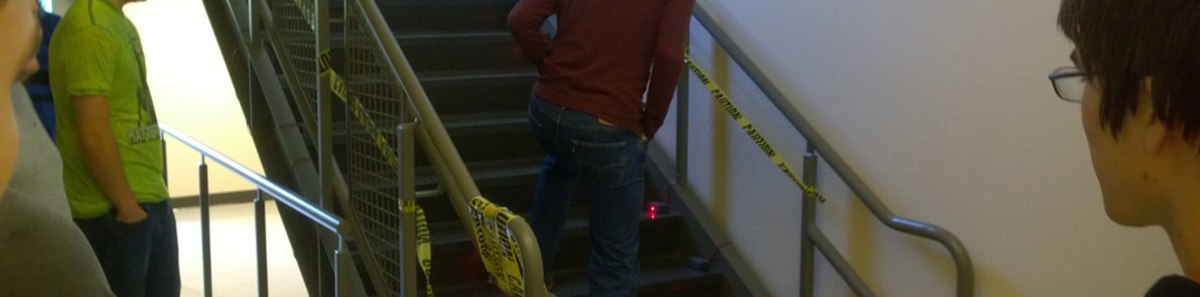
The sound coming out of the Arduino wasn’t producing quality sound so we looked into other options. We learned that creating the sounds on the fly wasn’t the best idea so we turned to using digital sound files and playing them with a Raspberry Pi. This drastically improved the quality of the sound and it allows us to expand the project in the future.
The sound is triggered using a optical switch. The switch works by aiming a laser at a photo resistor and reading out the value of the photo resistor. A photo resistor works by using the photo electric effect. When light photons hit the surface of a photo resistor, they push the electrons off of the semi-conductive plates on the surface which creates a current. This current can be measured by the Arduino to get an accurate readout of the light level on the photo resistor.
For More Detail: Staircase Meets Piano
-
Who provided the idea for the Staircase Piano project?
The idea was given to the club by Professor Barry Brown before the club was even formed. -
Why did the team switch from the Arduino to the Raspberry Pi?
The sound produced directly by the Arduino lacked quality, so they switched to playing digital sound files on the Raspberry Pi. -
How does the optical switch detect a step on the staircase?
It works by aiming a laser at a photo resistor and reading the value of the resistor when light photons hit its surface. -
What physical phenomenon allows the photo resistor to measure light?
The photoelectric effect pushes electrons off semi-conductive plates when light photons hit the surface, creating a measurable current. -
What method was initially used to create sounds with the Arduino?
The team created sounds using pulse width modulation and outputted that signal to a 3.5 mm stereo jack. -
When was the first completed Staircase Piano project displayed?
The first completed project was displayed in November 2014 as a final presentation before the end of the Fall 2014 semester. -
What component is used to read out the sensor data accurately?
The Arduino is used to read out the value of the photo resistor to get an accurate readout of the light level.
