
Summary of See-through solar concentrator harvests energy from sunlight
MSU researchers developed a transparent luminescent solar concentrator (TLSC) that turns windows and screens into invisible solar cells. Unlike earlier tinted versions, this device uses organic salts to absorb only ultraviolet and infrared light, converting them to electricity at the panel edges while remaining visually clear. This innovation enables nonintrusive solar energy generation on skyscrapers and mobile devices without compromising visibility or aesthetics.
Parts used in the Transparent Solar Concentrator:
- Transparent luminescent solar concentrator (TLSC)
- Organic salts
- Photovoltaic solar cells (thin strips)
- Glass panels or smartphone screens
A team of Michigan State University (MSU) researchers has created a transparent solar concentrator able to turn any window (or other sheet of glass, such as the screen for a smartphone) into a photovoltaic solar cell. What makes this development different? The panel is truly transparent.
Earlier attempts at building transparent solar cells resulted in panels with tinted glass and/or compromised visibility. Lead researcher Richard Lunt, an assistant professor of chemical engineering and materials science at MSU, says, “No one wants to sit behind colored glass. It makes for a very colorful environment, like working in a disco.”
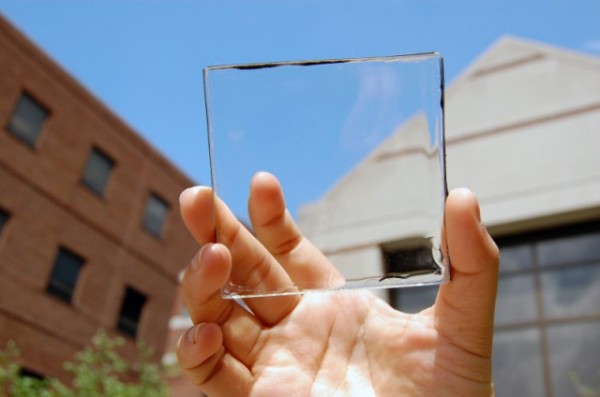
MSU researchers used a transparent luminescent solar concentrator (TLSC) that employs organic salts to absorb invisible wavelengths of light, such as ultraviolet and infrared light. “We can tune these materials to pick up just the ultraviolet and the near-infrared wavelengths that then ‘glow’ at another wavelength of sunlight,” Lunt explains. The “glowing” infrared light is then guided to the edges of the panel, where thin strips of photovoltaic solar cells convert it to electricity. “Because the materials do not absorb or emit light in the visible spectrum, they look exceptionally transparent to the human eye,” he adds.
The device “opens a lot of area to deploy solar energy in a nonintrusive way,” Lunt says. “It can be used on tall buildings with lots of windows or any kind of mobile device that demands high aesthetic quality, like a phone or e-reader. Ultimately, we want to make solar harvesting surfaces that you do not even know are there.”
For more Details: See-through solar concentrator harvests energy from sunlight
-
What makes this solar cell different from earlier attempts?
This panel is truly transparent and does not tint the glass or compromise visibility like previous colored versions. -
How does the device capture sunlight without blocking the view?
It uses organic salts to absorb invisible ultraviolet and infrared wavelengths while leaving the visible spectrum untouched. -
Where do the captured light waves go after absorption?
The absorbed light glows at another wavelength and is guided to the edges of the panel where solar cells convert it to electricity. -
Can this technology be used on mobile devices?
Yes, it can be applied to smartphones and e-readers that require high aesthetic quality. -
Why did researchers choose organic salts for this project?
These materials allow scientists to tune the device to pick up specific invisible wavelengths like UV and near-infrared light. -
Does the human eye see the light emitted by the organic salts?
No, because the materials do not emit light in the visible spectrum, they look exceptionally transparent.
