
Summary of Sino: bit – Changing Programming for Kids All Over the World
This article introduces the Sino: bit, a microcontroller designed to simplify electronics education for children by eliminating complex wiring. Based on the Calliope mini and compatible with Arduino IDE, it features an integrated 12x12 LED matrix capable of displaying characters from various languages, addressing limitations found in smaller displays. The device includes sensors like accelerometers and magnetometers, Bluetooth connectivity, and a battery connector for standalone operation. It holds OSHWA certification as China's first open-source hardware product, aiming to make coding accessible without the frustration of cable management.
Parts used in the Sino: bit Project:
- 12×12 LED matrix
- Accelerometer
- Magnetometer
- Bluetooth module
- Buttons
- Micro USB port
- Temperature sensor
- JST 3v battery connector
Creating projects with Arduino can be challenging for kids, this may cause children to lose interest in electronics and DIY projects. The most complicated part is usually the connections required to use a sensor, led matrix or other devices that can be connected to the Arduino (or other microcontrollers). Since all these devices are different and have different types of connections which need to be made in a certain way, electronic projects may get boring or too complicated for a kid to learn. If the objective is to teach a kid how to code without the extra complication of cables, then the Sino: bit is the perfect choice.
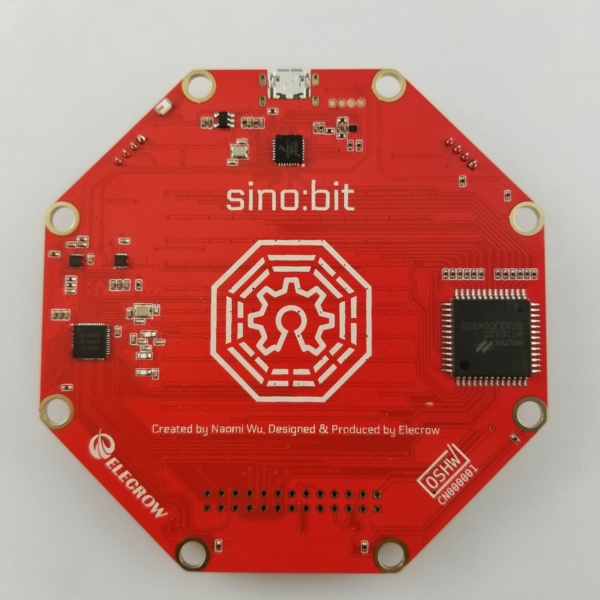
Sino: bit is a microcontroller designed for teaching computer education in China created by Naomi Wu a DIY enthusiast. It is based on Calliope mini and can be programmed with Arduino IDE. It includes a 12×12 LED matrix, accelerometer, magnetometer, Bluetooth, buttons, a micro USB for programming, temperature sensor and a JST 3v battery connector. The battery connector was included to run projects without the need to be connected to the computer at all times.
Usually, when learning how to program kids are taught “hello world” which is a simple code that displays the same message. The 12x 12 LED matrix has that size not only to allow kids to play with a huge number of LEDs, but also to allow kids from every nation to do and understand their hello world. This was a problem because Chinese, Japanese, Hindi and other languages contain characters that cannot be displayed in a small matrix.
It’s the first to obtain the OSHWA (open source hardware association) certification in China which is an association in charge of making the task of identifying and marketing open source hardware products clearer and more transparent.
Read more: Sino: bit – Changing Programming for Kids All Over the World
- Why is Sino: bit considered perfect for teaching kids?
It allows children to learn how to code without the extra complication of cables required by other devices. - What platform can be used to program the Sino: bit?
The device can be programmed using the Arduino IDE. - Why was the 12x12 LED matrix size chosen?
The large size allows kids from every nation to display their hello world because small matrices cannot show characters from languages like Chinese or Hindi. - Does the Sino: bit require a computer to run projects?
No, the included JST 3v battery connector allows projects to run without being connected to a computer at all times. - Who created the Sino: bit microcontroller?
It was created by Naomi Wu, a DIY enthusiast, for teaching computer education in China. - What significant certification did the Sino: bit achieve?
It was the first to obtain OSHWA (open source hardware association) certification in China. - How does the Sino: bit help prevent children from losing interest?
It removes the complicated connections usually required for sensors and LEDs that often make electronic projects too boring or difficult for kids.
