
Summary of SINGLE-ATOM TRANSISTOR ‘RECIPE’ SIMPLIFIES ATOMIC-SCALE FABRICATION
Researchers at NIST and the University of Maryland developed a repeatable, step-by-step method to fabricate single-atom and few-atom transistors by patterning a hydrogen-passivated silicon surface with a scanning tunneling microscope tip, then dosing with phosphine so phosphorus atoms attach only at exposed sites, enabling atom-scale control of geometry and quantum tunneling for potential qubit applications.
Parts used in theSingle-Atom Transistor Recipe:
- Silicon chip
- Hydrogen atoms layer (hydrogen-passivated silicon surface)
- Scanning tunneling microscope (STM) with a fine tip
- Phosphine gas (PH3)
- Individual PH3 molecules / phosphorus atoms incorporated into silicon
- Equipment to control and measure quantum tunneling/electron flow
Researchers at the National Institute of Standards and Technology (NIST) and the University of Maryland say they have developed a step-by-step recipe to produce single-atom transistors. by Rich Pell @ smart2zero.com
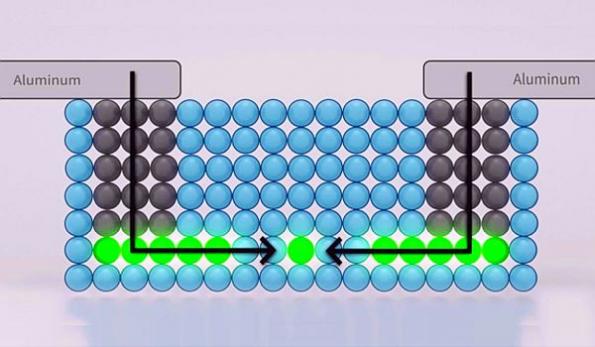
Transistors consisting of only several-atom clusters or even single atoms, say the researchers, promise to become the building blocks of a new generation of computers with unparalleled memory and processing power, but are notoriously difficult to fabricate in quantity. Now, using the new instructions, the researchers have become only the second in the world to construct a single-atom transistor and the first to consistently fabricate a series of single electron transistors with atom-scale control over the devices’ geometry.
The scientists demonstrated that they could precisely adjust the rate at which individual electrons flow through a physical gap or electrical barrier in their transistor. That strictly quantum phenomenon – known as quantum tunneling – only becomes important when gaps are extremely tiny, such as in the miniature transistors. Precise control over quantum tunneling is key, say the researchers, because it enables the transistors to become “entangled” or interlinked in a way only possible through quantum mechanics and opens new possibilities for creating quantum bits (qubits) that could be used in quantum computing.
To fabricate single-atom and few-atom transistors, the researchers relied on a known technique in which a silicon chip is covered with a layer of hydrogen atoms, which readily bind to silicon. The fine tip of a scanning tunneling microscope then removed hydrogen atoms at selected sites. The remaining hydrogen acted as a barrier so that when the researchers directed phosphine gas (PH3) at the silicon surface, individual PH3 molecules attached only to the locations where the hydrogen had been removed (see video).
Read more: SINGLE-ATOM TRANSISTOR ‘RECIPE’ SIMPLIFIES ATOMIC-SCALE FABRICATION
- What did researchers at NIST and the University of Maryland develop?
They developed a step-by-step recipe to produce single-atom and few-atom transistors with atom-scale control. - How do the researchers create patterned sites for single atoms on silicon?
They cover silicon with a hydrogen layer and use a scanning tunneling microscope tip to remove hydrogen at selected sites. - How are phosphorus atoms placed at specific locations on the silicon surface?
After removing hydrogen, researchers dose the surface with phosphine gas (PH3), which attaches at the exposed sites. - What quantum phenomenon do these transistors control precisely?
They precisely adjust quantum tunneling, the rate at which individual electrons flow through tiny gaps. - Why is precise control over quantum tunneling important?
Because it enables transistors to become entangled and opens possibilities for creating qubits for quantum computing. - How many groups have constructed single-atom transistors according to the article?
The researchers became only the second group in the world to construct a single-atom transistor. - What advantage did the researchers achieve over prior work?
They were the first to consistently fabricate a series of single electron transistors with atom-scale control over device geometry. - What role does the remaining hydrogen play after patterning?
The remaining hydrogen acts as a barrier so PH3 molecules attach only where hydrogen was removed.
