
Summary of Simple Audio Amplifier
This project builds a simple low-power audio amplifier using a TL071 operational amplifier, suitable as a concept demo or preamp. It uses a single 9 V supply with a voltage divider to bias the op amp at mid-rail, input and output coupling capacitors to block DC, a trimmer to adjust input level, and resistor/trimmer network to set gain. Assembly is on a breadboard and tested with an MP3 player. Safety disclaimer: the author is not responsible for damage during reproduction.
Parts used in the Simple Op-Amp Audio Amplifier:
- TL071 operational amplifier
- 47 kΩ resistor (two pieces)
- 1 kΩ resistor
- 100 kΩ trimmer
- 10 kΩ trimmer
- 10 μF capacitor (three pieces)
- 100 μF capacitor
- 9 V battery with wires or 9 V PSU
- Cable with 3.5 mm audio jack
- Small speaker
- Breadboard
- Wires
- Pliers and tweezers
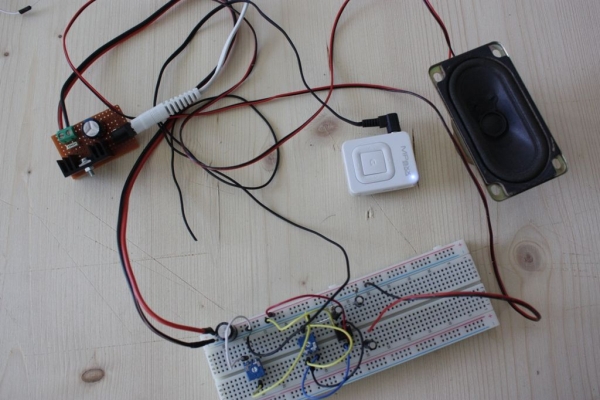
In most cases first project in electronics for beginners is building simple audio amplifier. That is because it requires small number of elements and not a lot of knowledge to build one.
For low power amplifiers we could use integrated circuits like TDA family. But I will show how to make amplifier using operational amplifier. This amplifier is only to proof the concept. It real use can be as preamp for guitar or something like that.
I am not hold responsible for any damage that occurred during reproduction.
Step 1: Parts and Materials
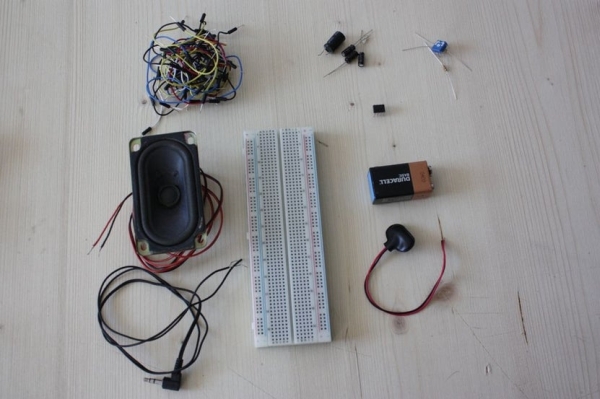
Parts:
– TL071
– two 47 kΩ resistors, 1 kΩ resistor, 100 kΩ trimmer and 10 kΩ trimmer
– three 10 μF capacitors and 100 μF capacitor
– 9 V battery with wires or PSU with 9V output
– cable with 3,5 mm audio jack
– small speaker
Tools:
– breadboard and wires
– pliers and tweezers
For testing you can use MP3 player, computer, mobile phone or any other device with audio output.
Step 2: Schematics
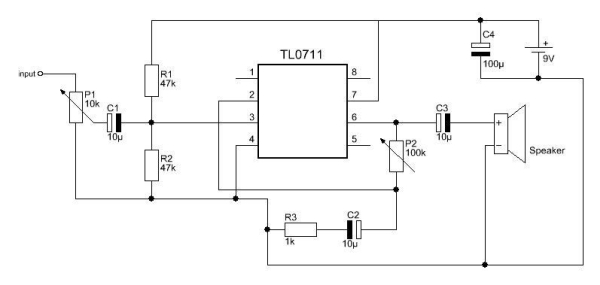
Picture above shows schematic for this project. Schematic isn’t my work. I just modified values.
Trimmer P1 is for adjusting input power. P1 is not necessary. Capacitor C1 is for filtering DC current out from audio signal. With resistors R1 and R2 we set voltage divider. With voltage divider we set working point of amplifier to half of the supplied voltage (4,5 V in this case). Resistor R3 and trimmer P2 are there to set amplifiers gain. Capacitor C3 is output capacitor and it is for filtering output frequency (low cut).
Step 3: Assembly on Breadboard
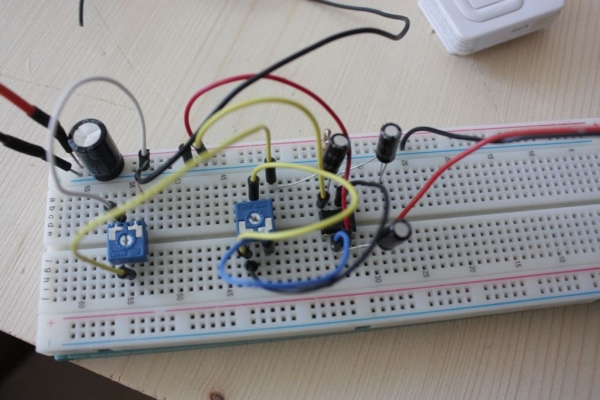
We assembled amplifier’s circuit on to breadboard. Here you can find how to work with breadboard.
Step 4: Testing
For testing I used MP3 player. Here is video from testing:
Step 5: Conclusion
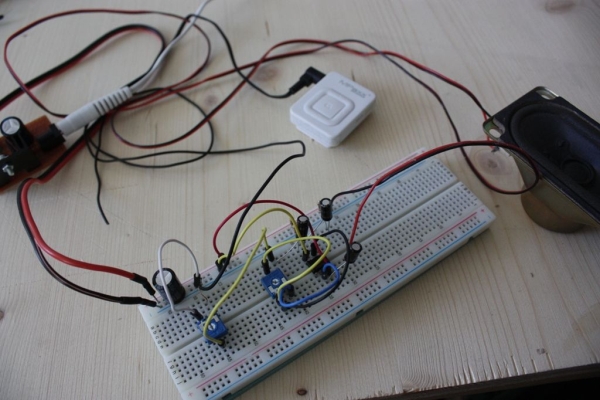
As I said before, I made this amplifier only to proof the concept. Concept was, that you can make audio amplifier using op amp and some other elements.
Have fun building and using this amplifier!
Source:
- What op amp is used in the project?
The project uses a TL071 operational amplifier. - What power supply does the amplifier require?
The amplifier uses a 9 V battery or a PSU with 9 V output. - What is the purpose of the voltage divider R1 and R2?
The voltage divider sets the amplifier working point to half the supply voltage (4.5 V). - What does capacitor C1 do?
Capacitor C1 filters DC out of the audio input signal. - Is trimmer P1 necessary?
Trimmer P1 is for adjusting input level but it is not necessary. - How is the amplifier gain adjusted?
Resistor R3 and trimmer P2 are used to set the amplifier gain. - What is the role of the output capacitor C3?
C3 is the output coupling capacitor and provides low cut filtering of the output. - What tools are needed to assemble the circuit?
You need a breadboard, wires, pliers, and tweezers for assembly. - What audio sources can be used for testing?
You can test with an MP3 player, computer, mobile phone, or any device with audio output.
