
Summary of PEN PLOTTER USES POLAR COORDINATES
This article describes a pen plotter that uses polar coordinates—distance from an origin and a rotating angle—instead of traditional Cartesian X-Y motion. The prototype evolved with limit switches for homing, a linear actuator for pen pressure, and a base encoder to correct arm rotation errors. The design excels at drawing curves and circles and could achieve a wide workspace if allowed full 360-degree rotation. A video demonstration accompanies the build.
Parts used in the Polar Coordinate Pen Plotter:
- Pen
- Movable carriage
- Rotating arm
- Limit switches (table ends and within the arm)
- Linear actuator (for pen pressure control)
- Encoder (mounted at the base for arm position correction)
- Table/work surface
To keep track of a location in a two-dimensional space, two measurements are needed. Most of the time, we would naturally think to do this by the Cartesian method, measuring position along one axis and then again along a second axis. But this isn’t the only way of keeping track of position. Polar coordinates, where the distance from the origin and an angle are used as the two measurements, works just as well, and sometimes can be a preferred method. This pen plotter tosses the expected Cartesian methodology we would typically expect in favor of this polar system.
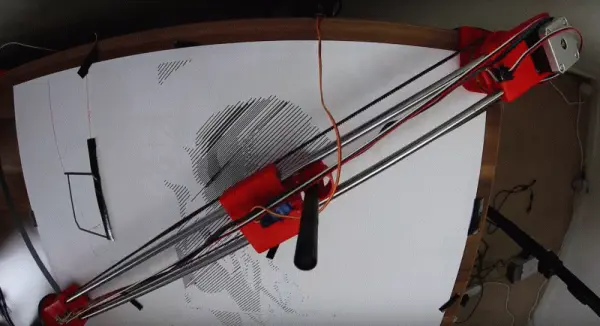
The first prototype that [André] built was a good proof of concept. A pen attached to a movable carriage on a single rotating arm produced passable drawings, but as all prototypes go this one needed some refinement. Limit switches at the ends of the table, as well as within the arm, served to orient the plotter so that it didn’t manually need to be zeroed out every time. A linear actuator was added to give finer control over the pen’s pressure on the table, and finally an encoder was added to the base of the plotter to more accurately correct positional errors in the rotating arm mechanism.
With everything said and done, the polar coordinate plotter seems to work just as well as its Cartesian cousins might, orienting it like this has some advantages as well. Specifically, it is more adapted to drawing curves or circles than an X-Y device might be able to, like we saw with this similar sand-drawing plotter. Also, if allowed to rotate its entire 360-degree reach instead of just the 90 degrees shown in the video, a machine like this could theoretically reach a wider workspace more easily than other plotters.
Source: PEN PLOTTER USES POLAR COORDINATES
- How does this plotter track position?
It uses polar coordinates: distance from the origin and an angle of rotation. - Can the plotter home itself without manual zeroing?
Yes; limit switches at the table ends and within the arm allow it to orient itself. - Does the build include a way to control pen pressure?
Yes; a linear actuator was added to provide finer pen pressure control. - How are rotational positional errors corrected?
An encoder at the base was added to more accurately correct positional errors in the rotating arm. - Is this plotter better at drawing curves and circles than Cartesian plotters?
The article states it is more adapted to drawing curves or circles than an X-Y device might be. - Could this design reach a wider workspace than typical plotters?
Yes; if allowed full 360-degree rotation instead of the shown 90 degrees, it could theoretically reach a wider workspace.
