
Summary of The party starter using arduino
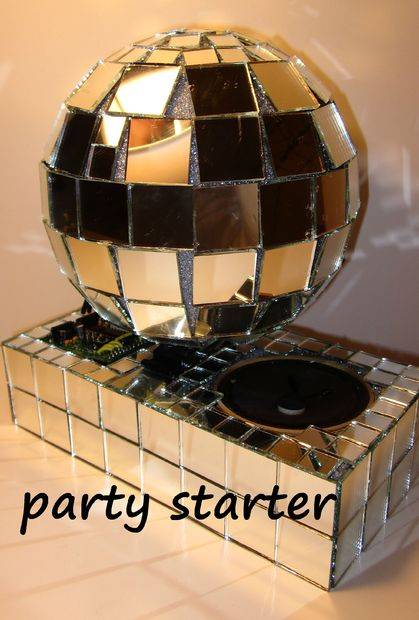
This article details a DIY desktop motorized musical disco ball project using an Arduino, mirror tiles, and glitter paint. Ideal for parties, it combines electronics with craft materials to create a rotating light show. The build involves painting a styrofoam sphere, adhering mirrors, mounting the ball on a servo via Velcro, and constructing a foam base to house the circuitry.
Parts used in the Desktop Motorized Musical Disco Ball:
- 6" Styrofoam sphere
- 8x4x2 Styrofoam block
- 1" mirror pieces
- .25" mirror pieces
- Krylon Glitter Paint
- Adhesive (Hot glue recommended)
- Velcro Pads
- Arduino Uno
- Adafruit Wave Shield
- Continuous Rotation Servo
- Battery Pack or Wall Wart
- Coat hanger wire
A desktop motorized musical disco ball. Great for holiday parties, impromptu dance-offs, and Tuesday afternoons. Bling, Music, Arduino, and glitter covered styrofoam; this Instructable has got what you need to get your boogie on. Fires need help go get going, so do parties. I recently moved from Hartford where my boys @HPSU(http://hartfordpartystarters.org/) would get it started every week. Now I live in boring Indiana, where there are no parties(Save church socials). With that in mind and the Party Season upon us, Lets make.
I have a glitch in the code, so it stutters every once in a while. No biggy for me, I’ll fix it later. I also would have showed myself dancing and partying in the video, but my clothes are matte and boring.
Step 1: Parts & Tools
Craft Parts
Velco Pads
Electronic Parts
Arduino IDE (I’m still rocking 21)
Solder Iron
Dremel
Glue Gun
Gloves/Face Mask/Eye Protection
Step 2: Underpainting The Ball
I wanted a base coat of reflective, shiny material so that anyplace where mirrors aren’t has some reflective quality. This ball used almost this entire mini can of spray paint. The holder for the ball was quickly made by twisting some coat hanger wire into a shape that’d hold the ball off the ground.
Step 3: Add the mirrors
Start with the center line and work your way out. Dab a bit of glue and place the tiles. Don’t worry too much about gaps, we are attaching square tiles to a circle after all. That’s why we painted it with sparkle paint.
I had to take a break for the night after the top section was completed. The glue I was using took FOREVER to dry. The next day I switch to the ol’ hot glue gun.
Step 4: Finish the Ball
Now that the mirrors are all set, We’ve got to use a clever way to attach it to the servo. Velcro will be our mating material. I don’t want to ruin a servo and it’ll be handy for transportation to be able to remove the ball.
Step 5: Make the Base
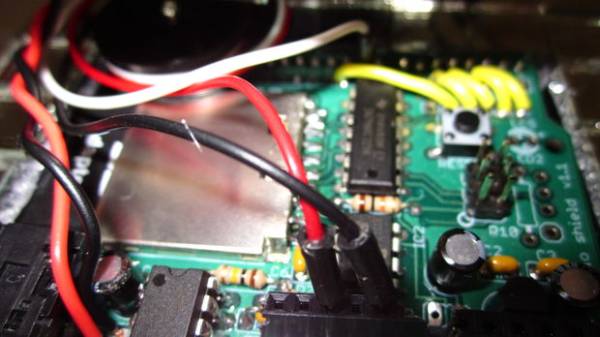
Start by marking off where you want the components to go on the foam block
Like all cutting, measure twice and cut once.
I used a Dremel to remove unwanted foam. There are foamcutters, you could use a lighter, smash and tear at it. Whatever your method, know that the servo must be tight so that all the torque and power is transferred to the party ball. Also dremeling this foam turned it into a fake snow like substance, Lots of Fun, bad for the lungs-WEAR PROTECTION.
Go around, add a ton mirrors. Try not to burn yourself on the glue or cut yourself on the glass.
Fore more detail: The party starter
-
What is the best adhesive for attaching mirror tiles?
Hot glue worked the best after trying other adhesives that took too long to dry. -
How do you attach the disco ball to the servo?
The author uses Velcro pads to attach the ball to the servo to prevent damage and allow for easy removal. -
What tool was used to cut the foam base?
A Dremel was used to remove unwanted foam from the block to make space for components. -
Why was the ball painted before adding mirrors?
A base coat of reflective, shiny glitter spray paint was applied so that gaps between mirrors still have a reflective quality. -
Is safety protection necessary when working with foam?
Yes, the article warns that dremeling foam creates a fake snow-like substance that is bad for the lungs, so gloves, face masks, and eye protection are required. -
What electronic components are required to power the device?
The project requires an Arduino Uno, Adafruit Wave Shield, a Continuous Rotation Servo, and either a battery pack or wall wart. -
How should the mirror tiles be placed on the sphere?
You should start with the center line and work your way out, dabbing glue and placing tiles without worrying too much about gaps.
