
Summary of PAPER TAPE READER SELF-CALIBRATES, SPEAKS USB
[Jürgen]’s Paper Tape Reader is a USB-connected optical reader that emulates a serial communications device to read punched paper tape. It uses LEDs and phototransistors with software-adjusted thresholds for automatic calibration, allowing it to handle varied tape materials and colors (including translucent tape). The design uses only through-hole components on stacked 1.6 mm PCBs with no separate enclosure, and can read up to about 500 characters per second once calibrated.
Parts used in the Paper Tape Reader:
- LEDs (light sources for each read channel)
- Phototransistors (optical sensors for each channel)
- Through-hole PCB stack (multiple 1.6 mm PCBs stacked as the device body)
- USB interface controller (to present the device as a serial communications device)
- Passive components (resistors, capacitors as required for LED and sensor circuits)
- Headers or connectors for PCB stacking and electrical interconnects
- Power supply components or USB power connections
- Microcontroller or MCU (performs analog readings, threshold calibration, and USB serial communication)
Input devices consisting of optical readers for punched paper tape have been around since the earliest days of computing, so why stop now? [Jürgen]’s Paper Tape Reader project connects to any modern computer over USB, acting like a serial communications device. Thanks to the device’s automatic calibration, it works with a variety of paper materials. As for reading speed, it’s pretty much only limited to how fast one can pull tape through without damaging it.
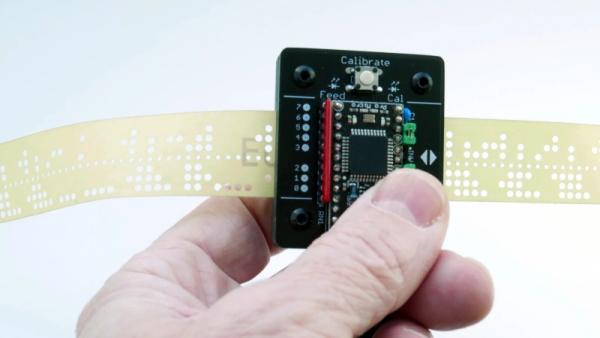
While [Jürgen]’s device uses LEDs and phototransistors to detect the presence or absence of punched holes, it doesn’t rely on hardware calibration. Instead, the device takes analog readings of each phototransistor, and uses software-adjusted thresholds to differentiate ones from zeros. This allows it to easily deal with a wide variety of tape types and colors, even working with translucent materials. Reading 500 characters per second isn’t a problem if the device has had a chance to calibrate.
Interested in making your own? The build section of the project has all the design files; it uses only through-hole components, and since the device is constructed from a stack of 1.6 mm thick PCBs, there’s no separate enclosure needed.
Paper tape and readers have a certain charm to them. Cyphercon 4.0 badges featured tape readers, and we’ve even seen the unusual approach of encoding an I2C byte stream directly onto tape.
Source: PAPER TAPE READER SELF-CALIBRATES, SPEAKS USB
- How does the Paper Tape Reader connect to a modern computer?
It connects over USB and acts like a serial communications device. - Can the reader handle different types and colors of tape?
Yes, it uses software-adjusted thresholds from analog phototransistor readings, allowing it to handle a variety of tape types and colors, including translucent materials. - Does the device require hardware calibration for different tapes?
No, it does not rely on hardware calibration; it calibrates automatically in software using analog readings. - What components are used for detecting punched holes?
LEDs provide light and phototransistors detect the presence or absence of holes via analog readings. - How fast can the reader read characters?
Reading around 500 characters per second is achievable after the device has calibrated. - Are special enclosure parts required for the build?
No separate enclosure is needed because the device is constructed from stacked 1.6 mm PCBs. - Are the components through-hole or surface-mount?
The project uses only through-hole components. - Where can one find design files to build the reader?
The build section of the project contains all the design files.
