
Summary of ONIO.ZERO RISC-V MICROCONTROLLER FUNCTIONS ON HARVESTED ENERGY
ONiO, a Norwegian IoT expert, has launched ONiO.zero, an ultra-low-power RISC-V microcontroller that operates entirely on harvested energy without batteries or capacitors. This battery-free chip reduces ownership costs and supports diverse power sources like solar, piezoelectric, thermal, and RF signals. Based on the RV32EMC architecture, it runs up to 24MHz at 1.8V but functions down to 450mV. The device includes integrated memory and multiple wireless transmitters, enabling compact, eco-friendly applications in wearables, medical devices, and sensors.
Parts used in the ONiO.zero:
- RISC-V based microcontroller
- RV32EMC instruction set architecture
- 1kB of mask ROM
- 2kB of RAM
- 8-32kB of ultra-low-power flash storage
- Crystal-free Bluetooth Low Energy transmitter
- IEEE 802.15.4 ultra-wide-band transmitter
- Optional 433MHz MICS radio transmitter
ONiO, a Norwegian healthcare-focused Internet of Things (IoT) expert has unveiled ONiO.zero, an ultra-low-power RISC-V-based microcontroller capable of operating solely from harvested energy — without needing a battery, capacitor, or any other means of energy storage. The company says “ONiO.zero is an ultra-low-power wireless MCU that uses energy harvesting technology.” This indicates that the ONiO.zero solely functions on energy harnessed from its surroundings. With no coin cell, no supercap, no lithium, no battery at all, the ONiO.zero is still a ton of power.
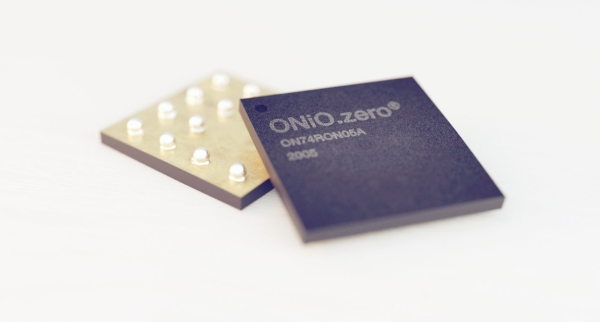
The company says:
Battery based solutions come with the inevitable caveat of battery replacement, which translates to an incremental cost, throughout their ownership. ONiO.zero circumvents this pain point and slashes the cost of ownership. It can be used to power sensors and devices for years, without having to spare a thought about maintenance — deploy and forget. ONiO.zero is self-powered and supports a wide range of power sources from multi-frequency RF bands supporting GSM and ISM to optional external sources like solar, piezoelectric, thermal and voltaic cells.
Having no battery means fewer components and a smaller design, which can easily be integrated into a wide range of solutions – be it fabrics, jewelry, watches, wearable medical devices, livestock or building sensors. More importantly, this makes for a cleaner, more eco-friendly solution.
The microcontroller is based on the open source RISC-V instruction set architecture, specifically the RV32EMC, which runs at up to 24MHz when fed with 1.8V. The controller can also operate at a lower voltage when required: 1V offers 6MHz, and 0.8V offers 1MHz. According to the company, the chip will continue to run – albeit at ever-decreasing speeds – as low as 450mV. There’s 1kB of mask ROM and 2kB of RAM included, along with 8-32kB of ultra-low-power flash storage capable of 100,000 write cycles and readable down to 850mV. The ONiO.zero also features a crystal-free Bluetooth Low Energy (BLE) transmitter, which operates at voltages as low as 850mV, an IEEE 802.15.4 ultra-wide-band (UWB) transmitter which operates in the 3.5-10GHz band, and an optional 433MHz MICS radio transmitter for industrial, scientific, and medical band use.
Read more: ONIO.ZERO RISC-V MICROCONTROLLER FUNCTIONS ON HARVESTED ENERGY
- What is the primary power source for ONiO.zero?
It operates solely from harvested energy from surroundings like multi-frequency RF bands, solar, piezoelectric, thermal, and voltaic cells. - Can ONiO.zero function without a battery?
Yes, it requires no coin cell, supercap, lithium, or any other means of energy storage. - How fast can the microcontroller run?
It runs at up to 24MHz when fed with 1.8V, though speeds decrease as voltage drops. - What is the minimum operating voltage?
The chip continues to run at voltages as low as 450mV. - Does the device include built-in wireless capabilities?
Yes, it features a crystal-free BLE transmitter, an IEEE 802.15.4 UWB transmitter, and an optional 433MHz MICS radio. - How much flash storage does ONiO.zero have?
It includes 8-32kB of ultra-low-power flash storage capable of 100,000 write cycles. - Is the microcontroller suitable for wearable devices?
Yes, its small design allows integration into fabrics, jewelry, watches, and wearable medical devices. - What are the main benefits of using this chip over battery solutions?
It slashes ownership costs by eliminating maintenance and battery replacement needs.
