
Summary of NO NEED FOR SPEED WITH THIS ARDUINO-BASED INKJET PRINTER
This article details a custom, slow-speed inkjet printer built for an art project by [HomoFaciens]. Unlike standard high-speed printers, this device prints continuously on paper rolls to create unique visual effects. The build repurposes an old 3D printer gantry and utilizes specific electronic components to drive an HP C6602 printhead with precise voltage pulses, allowing for adjustable DPI through line interlacing.
Parts used in the Slow Inkjet Printer:
- H-P C6602 inkjet cartridge
- ULN2803 Darlington array driver chip
- Gantry from an old 3D printer
- Roll of paper
- Arduino-based control system
When it comes to computers, it seems like the only thing that matters is speed. The more the better, in general, and the same applies to peripherals. We want the fastest network adapters, the fastest video card, and the fastest printer. So why in the world would anyone intentionally build a really slow inkjet printer? For art, of course.
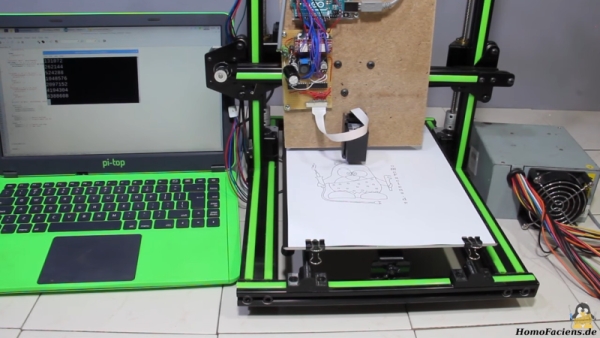
At least that’s the story [HomoFaciens] tells us in the video below. His efforts are in support of a friend’s art project, which seeks to print slowly but continuously on a roll of paper. [HomoFaciens]’s printer is based on an H-P C6602 inkjet cartridge, one of those high-priced consumables that make buying a new printer more attractive than replacing them once depleted. After figuring out how to drive the printhead — 5 to 6 μs pulses of 18 volts through a ULN2803 Darlington array driver chip seemed to do the trick — he mounted everything to the gantry of an old 3D printer. It’s interesting to watch the images slowly being built up — something that printers usually hide from prying eyes — and to see how the DPI count of the printer can be increased by interlacing each printed line.
Near the end of the video, we get a glimpse of his “tattoo gun printer”, which reminded us of all the other cool things he’s done over the years. From a CNC machine made from paperclips and cardboard to an encoder made from a wheel of resistors, [HomoFaciens] has some interesting designs that you really should check out.
Source: NO NEED FOR SPEED WITH THIS ARDUINO-BASED INKJET PRINTER
-
Why would someone intentionally build a really slow inkjet printer?
The printer was built specifically for an art project that seeks to print slowly but continuously on a roll of paper. -
How is the prinhead driven in this custom build?
The printhead is driven using 5 to 6 μs pulses of 18 volts sent through a ULN2803 Darlington array driver chip. -
What base hardware was used to mount the printing mechanism?
The components were mounted to the gantry of an old 3D printer. -
How can the DPI count of the printer be increased?
The DPI count can be increased by interlacing each printed line. -
What type of inkjet cartridge is utilized in this project?
The project uses an H-P C6602 inkjet cartridge, which is described as a high-priced consumable. -
Does the printer hide the image creation process like standard printers?
No, it is interesting to watch the images slowly being built up because this printer usually hides such processes from prying eyes. -
What other creative projects has the creator known for?
The creator is also known for a CNC machine made from paperclips and cardboard and an encoder made from a wheel of resistors.
