
Summary of NEW DIMENSION OF BRIGHTNESS: OSRAM HERALDS A NEW CHAPTER FOR LED PROJECTION
Osram's Ostar Projection Power LEDs deliver over 3,000 ANSI lumens using LEDs, offering three power classes (up to 1,500; 2,500; and >3,000 ANSI lm) in deep blue, blue, converted green, and amber. Improved chip and package tech enable series electrical connections on the copper board, lowering operating current and simplifying driver design and contacting, while allowing direct heat-sink coupling. Mechanical compatibility with previous products allows easy retrofits, positioning these LEDs as alternatives to high-pressure discharge lamps for bright projectors.
Parts used in the Ostar Projection Power:
- Ostar Projection Power LED components (12 product variants)
- Deep blue LED chips (440 nm)
- Blue LED chips (456 nm)
- Converted green LED chips (520 nm)
- Amber LED chips (614 nm)
- Copper LED board with series electrical connections
- Heat sink for direct LED coupling
- LED driver (simplified due to lower operating current)
As projectors grow more and more popular in home entertainment systems, so have the expectations of users. In addition to ever-higher resolutions, the focus is also on richer colors, contrasts and, of course, higher brightness. With the Ostar Projection Power family, Osram has succeeded for the first time in achieving projector brightness levels beyond the 3,000 ANSI lumen barrier using LEDs instead of conventional lamps, making them accessible to a broad market.
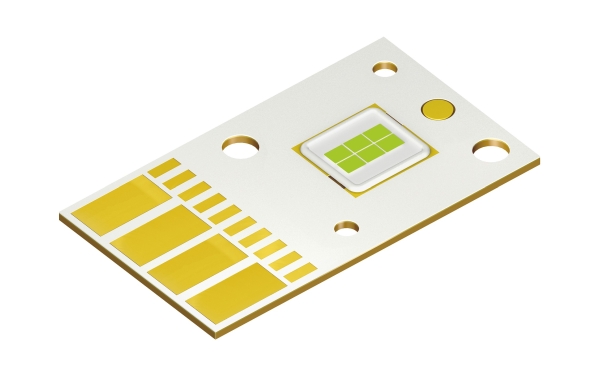
Depending on the ambient light conditions and the distance to the projection surface, requirements differ for the light source. With 12 new products, Osram is now able to offer three different power classes for RGB solutions in deep blue (440 nm), blue (456 nm), converted green (520 nm) and amber (614 nm). In the lowest power class, two chips of the same color per component provide projector brightness of up to 1,500 ANSI lm. In the mid-power class, four chips of the same color per component can achieve 2,500 ANSI lm. While in the highest power class, six chips of the same color per LED can achieve more than 3,000 ANSI lm. As a result, products from the Osram Ostar Projection Power family emerge as a clear alternative to the high-pressure discharge lamps previously used in projectors above 2,000 ANSI lm.
This leap in performance was achieved, among other things, by improved chip and package technology. The developers at Osram have fundamentally modified the individual LED chips allowing them to be electrically connected in a series on the copper board. The system designer benefits not only from a significantly lower operating current (with the same power consumption) and reduced complexity of the LED driver but also from the much simpler contacting of the component. In addition, direct coupling of the LEDs to a heat sink is possible – without additional isolation costs.
The mechanical design remains largely unchanged compared to previous products enabling fast and uncomplicated exchange of the products in existing projector systems.
Read more: NEW DIMENSION OF BRIGHTNESS: OSRAM HERALDS A NEW CHAPTER FOR LED PROJECTION
- What brightness levels can Ostar Projection Power LEDs achieve?
They can achieve up to 1,500 ANSI lm (lowest class), 2,500 ANSI lm (mid class), and more than 3,000 ANSI lm (highest class) depending on the product. - Which colors are available in the Ostar Projection Power family?
Available colors are deep blue 440 nm, blue 456 nm, converted green 520 nm, and amber 614 nm. - How did Osram increase LED projector brightness beyond 3,000 ANSI lm?
By improving chip and package technology, modifying LED chips for series connection on the copper board, and optimizing thermal coupling to heat sinks. - What are the benefits of electrically connecting chips in series on the copper board?
Series connection lowers operating current for the same power, reduces LED driver complexity, and simplifies component contacting. - Can the Ostar Projection Power LEDs be used in existing projector systems?
Yes, the mechanical design remains largely unchanged, enabling fast and uncomplicated exchange in existing systems. - Do these LEDs replace high-pressure discharge lamps in bright projectors?
Yes, they emerge as a clear alternative to high-pressure discharge lamps for projectors above 2,000 ANSI lm. - How many chips per component are used in each power class?
Lowest class uses two chips of the same color, mid class uses four chips, and highest class uses six chips per LED. - Is additional isolation required for heat-sink coupling?
No, direct coupling of the LEDs to a heat sink is possible without additional isolation costs.
