
Summary of Nandland Go Board – Your FPGA Playground
This article introduces the Nandland Go Board, an FPGA development board designed to simplify learning hardware programming. It explains that FPGAs (Field Programmable Gate Arrays) differ from standard software by allowing parallel operations through direct component wiring rather than sequential CPU processing. The board supports learning via VHDL and Verilog, offering a "Lego-like" experience for building complex digital systems from simple gates.
Parts used in the Nandland Go Board:
- FPGA
- VHDL coding language
- Verilog coding language
- Look-Up-Tables
- Registers
- RAM
- Digital Signal Processing components
- And-gates
- Or-gates
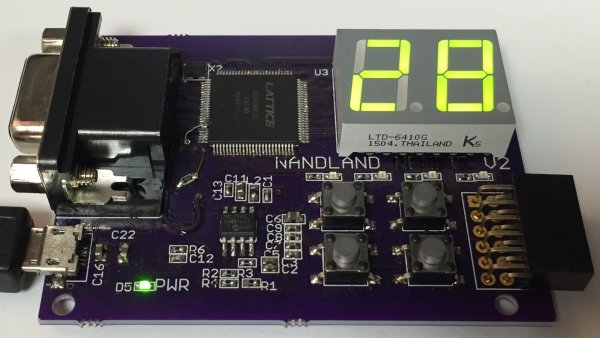
Nandland Go Board – Your FPGA Playground
My name is Russell and I am the creator of www.nandland.com. I started Nandland to increase the usage of FPGAs by making them easy to use. I am thrilled to announce after months of hard work the creation of the next phase of that plan: The first FPGA development board you should buy!
What is an FPGA?
FPGA stands for Field Programmable Gate Array. An FPGA is a component that can be thought of as a giant ocean of digital components that can be connected together by wires. The code that you write makes real physical connections with wires to perform the function that you need. What makes FPGAs special is that they are very good at performing a large number of operations in parallel (at the same time). They are used in high-speed, high-performance tasks such as image processing, telecommunications, digital signal processing, high-frequency stock market trading, and many others.
FPGAs are also fun to design with! The code that you write is at the lowest possible level. It’s like using simple Lego Bricks to build the Millennium Falcon, FPGAs allow you to make something very complex out of something simple. The Nandland Go Board is an amazing platform for you to become familiar with hardware programming in the two coding languages used: VHDL and Verilog.
How is an FPGA different from Software?
There are two main programming languages that a FPGA designer uses: VHDL and Verilog. This type of code is fundamentally different than software! The main difference is that software code targets a processor, whereas hardware code does not.
A Central Processing Unit (CPU) or just processor, is the central component that software designers need to understand. A CPU processes instructions one at a time to perform a task. A software designer writes code in a language like C that gets compiled by a compiler. The job of the compiler is to take the high-level code that the software designer writes and convert it into low-level code that the processor can understand. It must be understood that in hardware design, there is no compiler! There is nothing to take your code and turn it into instructions the way that a software compiler does.
This is because an FPGA designer does not have a processor to target. Instead, they have thousands or hundreds of thousands of discrete digital components such as Look-Up-Tables, Registers, RAM, Digital Signal Processing components, and others. An FPGA designer writes code at a much lower level than the software engineer. The FPGA designer is targeting the individual components of the FPGA, and has control over everything!
Digital Design is fun to learn, because it is the lowest-level of programming that is possible to do. Your code is used to literally run wires between components such as and-gates and or-gates!
Read more: Nandland Go Board – Your FPGA Playground
- What is an FPGA?
An FPGA stands for Field Programmable Gate Array, which acts as a giant ocean of digital components connected by wires. - How is an FPGA different from Software?
Software targets a processor that processes instructions one at a time, while hardware code targets discrete digital components without a compiler. - Does the Nandland Go Board support multiple coding languages?
Yes, the board allows users to become familiar with hardware programming using VHDL and Verilog. - What makes FPGAs special compared to other processors?
FPGAs are very good at performing a large number of operations in parallel at the same time. - Can you use a compiler for FPGA design?
No, there is no compiler in hardware design because an FPGA designer does not have a processor to target. - What level of programming does hardware design represent?
Digital Design is the lowest-level of programming possible, where code literally runs wires between components. - What are some high-speed tasks FPGAs are used for?
FPGAs are used for image processing, telecommunications, digital signal processing, and high-frequency stock market trading. - What discrete digital components can an FPGA designer control?
An FPGA designer has control over thousands or hundreds of thousands of components such as Look-Up-Tables, Registers, RAM, and Digital Signal Processing components.
