
Summary of Motion Triggered Fog Machine using an Arduino
Here’s a concise summary and the requested structured lists. Summary (under 100 words) A motion-triggered fog machine using an Arduino, an HC-SR04 ultrasonic distance sensor as a digital tripwire, and a relay to switch the fog machine’s remote. The build requires a transistor, diode, resistor, wiring, project box, perfboard, and a fog machine with a corded remote. The guide covers parts, wiring/schematic, relay pin considerations, soldering, and enclosure assembly to create fog only when someone approaches.
Parts used in the Motion Triggered Fog Machine:
- Relay (12VDC/125VAC or comparable)
- HC-SR04 Distance Sensor
- Transistor (e.g., 2N7052 NPN)
- Diode (e.g., 1N4003)
- Resistor (220 ohm)
- Battery connector (for 9V battery)
- Project box (2x3 inch used)
- Shrink tubing
- Copper clad perfboard
- Stranded hookup wire (for remote cable)
- Solid core hookup wire (for circuitry/Arduino)
- Fog machine with a corded remote and switch
- Arduino (e.g., Arduino Uno)
- Soldering iron
- Multimeter
- Dremel (for cutting enclosure holes)
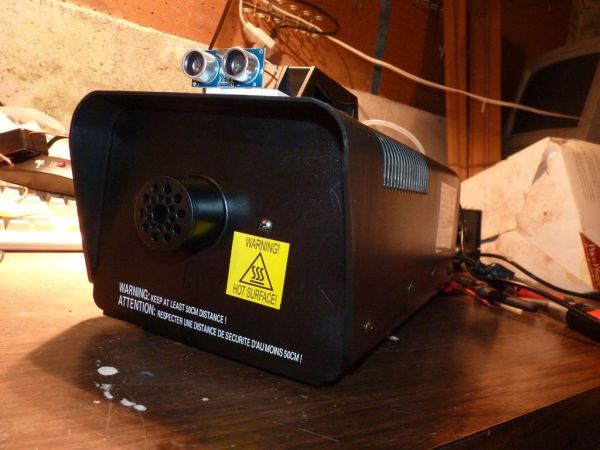
Fog machines can be unruly beasts. Especially the non-professional models you buy for halloween. With low duty cycles, causing massive amounts of fog when you don’t need it, and no fog when you do. Wouldn’t it be nice to have fog only when people come up to your house? Yeah, I thought so too. Here we are going to make a motion triggered fog machine that will turn on when ever someone comes up to your door.
Step 1: The Parts
Here is what you are going to need to complete this Instructable.
Everything linked here is the exact same part I used but you can always substitute comparable parts.
*A Relay
($4.99)
I used a 12vDC/125vAC relay from RadioShack. (I’m sure you can find a similar one somewhere else for cheaper) You can use what ever you like as long as the reed switch is rated for current up to 120vAC. Although this one says the coil requires 12vdc you should be able to get away with using a 9v battery.
http://www.radioshack.com/product/index.jsp?productId=2062482&filterName=Category
http://www.newark.com/nte-electronics/r73-5d10-12/power-relay-spdt-12vdc-10a-pc-board/dp/02H7519 (This one should work exactly the same)
http://www.newark.com/jsp/search/productdetail.jsp?sku=94C2790 (Your 9v batteries probably wont last long in the 12v relay so you may want to try a 6v one)
*A Distance Sensor
($13)
This is the HC-SR04 Distance Sensor. We will use it as a digital tripwire. This one is cheaper than the “Ping” sensor and just as easy to use. I will provide the appropriate libraries later on so you don’t unnecessarily rip out your hair.
*A Transistor
($0.25)
You are going to need something to control the 9v power supply. If you decide to use a 5v relay you should still use a transistor to protect your Arduino from the relay.
http://www.newark.com/fairchild-semiconductor/2n7052/bipolar-transistor-npn-100v/dp/18C9246?Ntt=2N7052
*A Diode
($0.04)
The diode is to keep you from ruining your transistor. Admittedly I didn’t use a diode for my first version of this and it worked fine but after reading more it started looking like a better idea.
http://www.newark.com/vishay-general-semiconductor/1n4003-e3-54/standard-diode-1a-200v-do-204al/dp/05R5981
*A Resistor
($0.03)
The resistor is for a little added protection for your Arduino from the 9v battery and the relay. I used a 220OHM resistor.
http://www.newark.com/multicomp/mccfr0w4j0221a50/resistor-carbon-film-220ohm-250mw/dp/58K5029?Ntt=58K5029
*A Battery Connector
($2.99 for 5)
You need to connect to your battery some how dont you?
http://www.radioshack.com/product/index.jsp?productId=2062219
*A Project Box
($2.69)
I used a 2×3” project box from radio shack but you should probably look elsewhere to get a better price.
http://www.radioshack.com/product/index.jsp?productId=2062279
*Shrink Tubing
You want your wires to stay neat and tidy dont you?
*Copper Clad PerfBoard
To put your project on. I cut mine to about 1 1/2” x 1 3/4”
http://www.radioshack.com/product/index.jsp?productId=2102843&filterName=Price&filterValue=under+%243.99
*Stranded Hookup wire
You need stranded wire to go from the remote to the project box. Use stranded wire for this because it can handle the constant movement this wire will endure. It also must be able to handle the AC current.
http://www.radioshack.com/product/index.jsp?productId=2049745
*Solid Core Hookup Wire
This wire is used for hooking up your circuitry and for connecting to the Arduino.
http://www.radioshack.com/product/index.jsp?productId=2036274
*A Fog Machine WITH A REMOTE!
(I paid $30 for mine but you may find them at better prices depending what time of year it is)
You need to make sure you get a fog machine with a corded remote with a switch or else trying to follow this intractable could get tricky. (if you like tricky then go ahead and get one with a different style remote) We are going to modify the remote so the whole fog machine will not be turned off completely and it will not need to heat up again every time you want fog.
(This is the one I bought but they are sold out for now so I have another one listed aswell)http://www.partycity.com/product/fog+machine+400+with+remote.do?sortby=ourPicks&size=all&from=Search&navSet=fog
http://www.halloweensuperstore.us/Foggie_400_Watt_Fog_Machine_W_Remote_p/v-915.htm
——-TOOLS——
*Soldering Iron
Do I really need to go into why you need this?
http://www.sparkfun.com/products/9672
*Multi-Meeter
To Check continuity and for shorts.
http://www.sparkfun.com/products/9141
*A Dremel
You are going to use it to cut holes in your project box
http://tinyurl.com/43mbpyt
And I suppose thats it.
Oh and an Arduino!
Step 2: Schematic
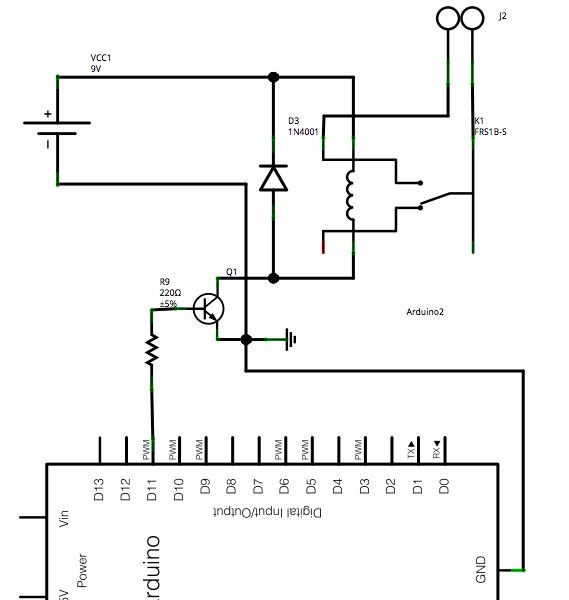
Follow the schematic and everything will turn out fine ^_^
Step 3: The Relay
Our relay is a little different than the one used in the schematic. Our coil pins are right next to each other.
Check the data sheet for your specific relay to make sure you are connecting to the right pins.
Tack down one pin of the relay then you can continue to solder on the other components.
A Distance Sensor
A Transistor
An Arduino
For more detail: Motion Triggered Fog Machine using an Arduino
- What sensor is used as the digital tripwire?
The HC-SR04 distance sensor is used as the digital tripwire. - Can I use a 9V battery with a 12V relay?
The article suggests you should be able to get away with using a 9V battery even though the relay coil is rated 12V, but notes 9V batteries may not last long. - Why is a transistor needed in the circuit?
The transistor is used to control the 9V power supply and to protect the Arduino from the relay. - Is a diode required and why?
The diode protects the transistor from back-emf; the author recommends using one though an earlier version worked without it. - What type of fog machine remote is required?
You need a fog machine with a corded remote that has a switch so the remote can be modified as described. - What resistor value is used for protection?
A 220 ohm resistor is used for added protection for the Arduino from the 9V battery and relay. - What wiring types are recommended for the remote connection?
Use stranded hookup wire for the remote to handle constant movement and AC current. - Do I need to check relay pinouts?
Yes, check your relay data sheet because the coil pins on the relay used are adjacent and pin layout can vary. - What tools are listed as necessary?
Soldering iron, multimeter, and a Dremel are listed as necessary tools.
