
Summary of Microsemi very low power RF chip for patient monitors
Summary: The ZL70250 is an ultra-low-power RF transceiver for short-range wireless applications (795–965 MHz) delivering 186 kbit/s. It integrates an RF transceiver and MAC, operates from 1.1–1.9 V with transmit/receive currents under 2 mA, and requires very few external components. Its CSP form factor and minimal external parts enable tiny, battery- or energy-harvesting-powered devices for sensor networks, remote control, voice links, and medical patient monitors.
Parts used in the ZL70250 project:
- ZL70250 ultra-low-power RF transceiver (CSP package)
- Crystal
- Bias resistor
- Supply decoupling capacitor
- Standard microcontroller or digital signal processor (SPI and two-wire interfaces)
- Battery (coin cell examples: 1.4 V or 1.5 V) or energy-harvesting power source
- Antenna (for 795–965 MHz operation)
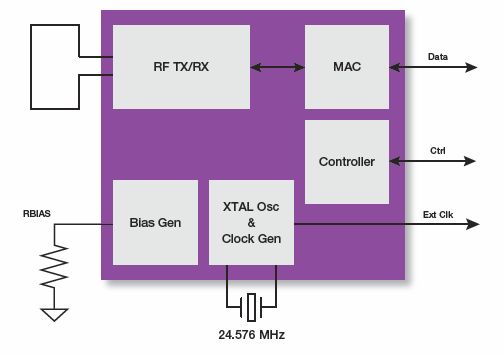
The ZL70250 ultra-low-power radio frequency (RF) transceiver provides a wireless link in applications where power consumption is of primary importance. The transceiver’s ultra low-power requirements allow battery miniaturization or the use of energy-harvesting methods, enabling devices with an extremely small form factor. The availability of the transceiver in a CSP form factor combined with the extremely low number of external components also contributes in minimizing the application footprint.
The ultra low-power device operates in unlicensed frequency bands between 795 and 965 MHz and offers a data rate of 186 kbit/s to support voice communication. For data communication, the ZL70250 supports extremely low power consumption in packet-based networks. The device includes the RF transceiver as well as a Media Access Controller (MAC) that performs most link support functions including Received Signal Strength Indication (RSSI), Clear Channel Assessment (CCA), sniff, preamble and sync, packetization, and whitening. The device uses standard interfaces, enabling easy integration with a standard microcontroller or Digital Signal Processor (DSP).
Ultra-Low-Power Transceiver for Short-Range Wireless Applications
- Ultra low transmit and receive current of less than 2 mA enables extremely long battery life, very small battery size, or energy harvesting
- Low supply voltage of 1.2 V to 1.8 V further reduces power consumption
- Operates between 795 and 965 MHz (915-MHz
- ISM band in North America; 868-MHz SRD band in Europe)
- High data rate (186 kbit/s raw) allows short data bursts and supports bidirectional voice communication
- Very few external components (only crystal and bias resistor required) and a CSP package enable end-devices with very small footprint
- Standard interfaces: SPIbus master for packet data and two-wire for status and control
- Integrated MAC performs all link layer basic functions, enabling simple and low-power controller functions
Applications
- Battery-powered wireless sensor network
- Applications relying on energy harvesting
- Wireless communication with very long battery life
- Voice communication
- Remote control
Microsemi has introduced a very low power RF transceiver for short-range wireless applications which draws only 2mA of current when transmiting and receiving data.
The radio operates in unlicensed frequency bands between 795MHz and 965MHz and will supprt a data rate of 186kbit/s.
The ZL70250 radio transceiver is designed to operate from supply voltage (1.1V to 1.9V).
“Lead customers have reported outstanding power saving capabilities when using compact coin cell batteries with 1.4V and 1.5V supply,” said Mauricio Peres, director of business development of Microsemi’s ultra low power (ULP) group.
The device has a 2mm x 3mm die size and can be integrated into a single chip scale package (CSP) with the exception of a bias resistor and a supply decoupling capacitor.
One application for the radio transceiver is in patient monitors. According to the supplier, wireless technology in the medical industry has limitations to battery life when transporting multiple vital sign streams to a display instrument.
For more read: Microsemi very low power RF chip for patient monitors
- What frequency bands does the ZL70250 operate in?
The ZL70250 operates in unlicensed frequency bands between 795 MHz and 965 MHz. - What data rate does the ZL70250 support?
The device supports a raw data rate of 186 kbit/s. - How much current does the ZL70250 draw when transmitting or receiving?
Transmit and receive current is less than 2 mA. - What supply voltage range does the ZL70250 require?
The transceiver operates from approximately 1.1 V to 1.9 V (noted elsewhere as 1.2 V to 1.8 V in the article). - What external components are required to use the ZL70250?
Very few external components are required: a crystal, a bias resistor, and a supply decoupling capacitor. - Does the ZL70250 include MAC functions?
Yes, it integrates a Media Access Controller performing RSSI, CCA, sniff, preamble and sync, packetization, and whitening. - What interfaces does the ZL70250 use to connect to a controller?
It uses a SPIbus master for packet data and a two-wire interface for status and control. - What applications are suggested for the ZL70250?
Suggested applications include battery-powered wireless sensor networks, energy-harvesting systems, long-life wireless communication, voice communication, remote control, and patient monitors. - How does the CSP form factor benefit designs?
The CSP form factor combined with few external components minimizes application footprint and enables extremely small end-devices.
