
Summary of MEET THE BREADBOARD COMPATIBLE MCP4901 DAC BASED BREAKOUT BOARD
Earth People Technology launched a breadboard-compatible breakout board using the eight-bit MCP4901 DAC chip, aimed at prototyping and Arduino-family development boards. The board outputs analog voltages from 0 to VREF (adjustable via onboard potentiometer) with 0–255 resolution, includes double-buffered registers for synchronous LDAC updates, a Power-on Reset circuit, resistive string architecture for low DNL and fast settling, and is specified up to +125°C.
Parts used in the MCP4901 DAC Breakout Board:
- MCP4901 eight-bit DAC chip
- On-board potentiometer for VREF adjustment
- LDAC pin circuitry (for double-buffered synchronous updates)
- Power-on Reset (POR) circuit components
- Breadboard-compatible PCB with header pins
- Resistive string network (internal to MCP4901)
- VCC and ground power connections
US-based technology Product development company, Earth People Technology, recently announced the launch of a DAC (digital to analog converter) breakout board that is based on the popular eight-bit MCP4901 DAC Chip.
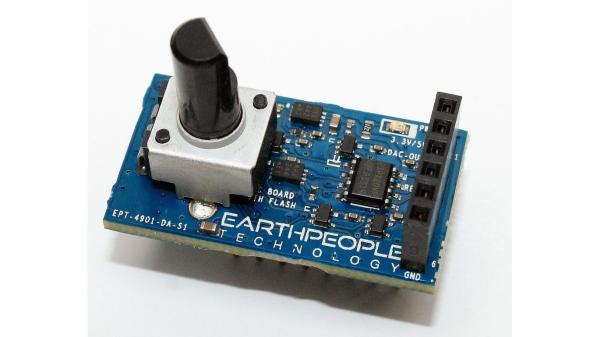
The new breakout board, in line with the nature of the products developed by the company, comes with breadboard compatibility which makes it easy to use for prototyping and DIY applications. Speaking on the features, the company announcement mentioned that the board was designed to suit applications involving development boards like the Arduino family of boards. In their words –
“This DAC board features the MCP4091 eight-bit Digital to Analog chip. It is designed to fit into a breadboard and connect to an Arduino board.”
The MCP4091 DAC on which the board is based generates analog voltages from the ground to its voltage reference (VREF) — which can be adjusted to a value between the applied VCC and ground using an on-board potentiometer. The DAC takes digital inputs and converts them to an analog value between 0-255 with 0 being ground and 255 being VREF.
Describing the features of the breakout board, the announcement mentioned that –
“The device includes double-buffered registers, allowing synchronous updates of the DAC output using the LDAC pin,” and also “incorporate a Power-on Reset (POR) circuit to ensure reliable power-up”. It also features “a resistive string architecture, with its inherent advantages of low Differential Non-Linearity (DNL) error and fast settling time”, and ” is specified over the extended temperature range (+125°C).”
Read more: MEET THE BREADBOARD COMPATIBLE MCP4901 DAC BASED BREAKOUT BOARD
- What DAC chip is used on the breakout board?
The board uses the MCP4901 eight-bit Digital to Analog Converter chip. - Is the breakout board compatible with breadboards and Arduino boards?
Yes, the board is designed to fit into a breadboard and connect to Arduino development boards. - What output voltage range can the MCP4901 produce?
It generates analog voltages from ground to VREF, where VREF can be adjusted between VCC and ground via the on-board potentiometer. - What resolution does the MCP4901 DAC provide?
The DAC converts digital inputs to an analog value between 0 and 255, providing eight-bit resolution. - Does the board support synchronous DAC updates?
Yes, it includes double-buffered registers allowing synchronous updates of the DAC output using the LDAC pin. - Is there any power-up reliability feature on the board?
Yes, the device incorporates a Power-on Reset (POR) circuit to ensure reliable power-up. - What architecture does the DAC use for conversion?
It uses a resistive string architecture, offering low Differential Non-Linearity error and fast settling time. - What temperature range is the MCP4901 specified for?
The MCP4901 is specified over the extended temperature range up to +125°C.
