
Summary of MEET THE $795 USB 4.0 SWITCH FOR USB4 PRODUCT DEVELOPMENT
The article discusses MCCI's launch of the Model 3141 USB4 Switch, a tool designed to accelerate USB4 device development. This programmable switch connects two USB Type-C receptacles to a single plug, supporting USB4, Thunderbolt 3, and legacy protocols. It automates device connection for stress testing, peripheral switching, and continuous integration, integrating with Microsoft tools and Windows Hardware Lab Kit to identify hardware-firmware-software bugs without physical cable manipulation.
Parts used in the Model 3141 USB4 Switch:
- Model 3141 USB4 Switch
- Two USB Type-C receptacles
- Single USB Type-C plug
- MCCI Model 3101
- Microsoft Type-C ConnEx Connection Exerciser
- Windows Hardware Lab Kit (HLK)
- Control computer with simple UI
- Continuous integration systems
A few months back, the specification for the USB 4.0 was released by the USB implementers forum with a promise of 2x the speed of USB3.2; 40GB/s and while there currently no devices in the market based on it, its features are definitely things device manufacturers will be leveraging on in a few months to increase their competitive advantage. This is why USB Solutions Provider, MCCI, recently announced the launch of their USB4 Switch which is targetted at helping developers and electronics companies fast track the development of their USB4-based devices.
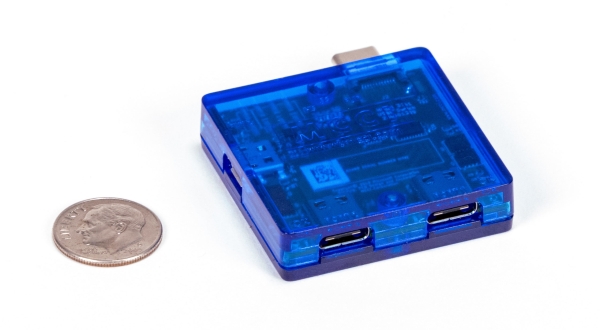
According to MCCI’s product page, the new switch which is called the “3141 USB4™ Switch“, is a computer-controlled programmable 2:1 switch, connecting two USB Type-C™ receptacles to a single Type-C plug. It is compatible with USB4 hosts and devices, as well as older protocols such as Thunderbolt™ 3, USB 3.2, USB 2.0, USB Type-C Alternate Modes, and of course Power Delivery.
The Model 3141 USB4 Switch automates connect/disconnect of one or two devices to a USB Type-C port. It can be used in stress testing, switching between peripherals (for example, a dock and a display), or any automated reconfiguration of a USB Type-C port. It is compatible with the MCCI Model 3101 / Microsoft Type-C ConnEx Connection Exerciser tools and scripts and integrates with the tools in the Windows Hardware Lab Kit(HLK) to support participation in the Windows Hardware Compatibility Program.
Beyond formal compatibility testing of your final products, the Model 3141 has value throughout your product development cycle. In our experience, long-run randomized switching on a USB Type-C port is highly effective in exposing bugs in the hardware-firmware-software stack on both hosts and devices. Developers can use it with a simple UI on the control computer to connect/reconnect a device under test without physically manipulating cables, reducing wear on fragile prototypes. Continuous integration systems can use it to reproducibly test key scenarios of devices under test with a variety of test setups.
Read more: MEET THE $795 USB 4.0 SWITCH FOR USB4 PRODUCT DEVELOPMENT
- What is the primary function of the Model 3141 USB4 Switch?
It automates the connect/disconnect of one or two devices to a USB Type-C port. - Does the switch support older USB protocols?
Yes, it is compatible with Thunderbolt 3, USB 3.2, USB 2.0, USB Type-C Alternate Modes, and Power Delivery. - How does this tool help developers find bugs?
Long-run randomized switching exposes bugs in the hardware-firmware-software stack on hosts and devices. - Can the switch be used for stress testing?
Yes, it is useful for stress testing and switching between peripherals like docks and displays. - Which software tools integrate with the Model 3141?
It integrates with the MCCI Model 3101, Microsoft Type-C ConnEx Connection Exerciser, and Windows Hardware Lab Kit. - Does using the switch reduce wear on prototypes?
Yes, developers can connect or reconnect devices via a UI without physically manipulating cables. - Is the switch compatible with USB4 hosts?
Yes, it is fully compatible with USB4 hosts and devices. - What is the price mentioned for the USB4 switch in the article?
The article mentions a price of $795 for the USB 4.0 switch.
