
Summary of LOW COST HAPTIC VR GLOVES WORK WITH HACKED STEAM GAMES
Lucas VRTech developed low-cost, force-feedback haptic gloves for Steam VR using 3D printing and off-the-shelf components. The design employs springs, servo motors, and potentiometers controlled by an ESP32 board to simulate finger resistance via cable tension. While the current hardware lacks precise force control due to hard stops, the project utilizes a custom Steam driver called OpenGloves and community mods to enable gameplay compatibility.
Parts used in Lucas VRTech Haptic Gloves:
- Sprung-loaded spool (ID card reel type)
- Cables
- Pegs
- Servo motors
- Potentiometers
- ESP32 development boards
- 3D printed glove mount
- 3D printed per-finger units
[Lucas VRTech] has made some significant progress with building force-feedback type haptic gloves for use with Steam VR games. The idea is pretty straightforward: the end of the finger is attached to a cable, which is pulled from inside a sprung-loaded spool; the kind used for hanging ID cards on.
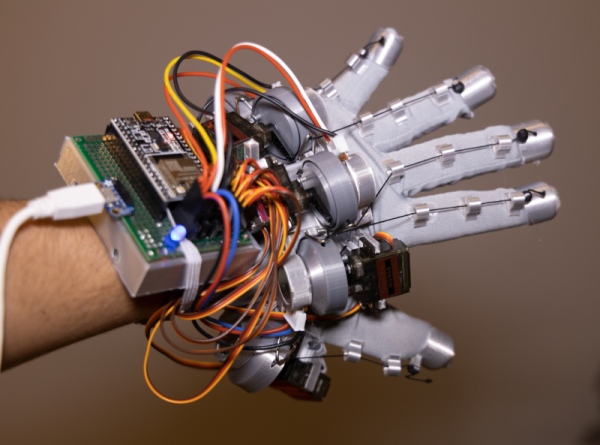
The spool body can rotate, but a peg protruding from it engages with the arm of a co-located servo motor. This produces a programmable stop position. But it is a hard stop, and it is not possible with the current hardware to detect precisely when the stop is reached, nor is it possible to control the force it is pushing with. Such features are not difficult to achieve, its just a matter of a little more development with some custom mechatronics.
The current prototype has a focus on cost, which is great as an early development platform. By leveraging 3D printing and off-the-shelf parts that are easy to source; just a handful (chuckle!) of potentiometers, some servo motors and one from any number of ESP32 dev boards and you’re done. The real work is on the software side of things, as the games themselves need to be modified to play ball with the VR glove hardware. This has been achieved with a combination of a custom steam driver they call OpenGloves, and community developed per-game mods. A few titles are available to test right now, so this is definitely something some of us could build in a weekend and get involved with.
The hardware source for the glove mount and per-finger units can be found on the project GitHub, together with the ESP32 source for Arduino.
For some other haptic-related inspiration, here’s a force-feedback mouse, and for a more hand-off feedback, we have a wind-blaster project.
Source: LOW COST HAPTIC VR GLOVES WORK WITH HACKED STEAM GAMES
-
How does the glove generate force feedback?
The end of each finger is attached to a cable pulled from a sprung-loaded spool by a servo motor. -
Can the current hardware detect when the stop position is reached?
No, it is not possible with the current hardware to detect precisely when the hard stop is reached. -
What software is required to make the gloves work with games?
Games must be modified using a custom Steam driver called OpenGloves and community developed per-game mods. -
Is this project suitable for building in a weekend?
Yes, because it leverages 3D printing and easy-to-source parts, making it feasible for a weekend build. -
Where can I find the hardware source files?
The source for the glove mount and per-finger units is available on the project GitHub. -
Does the current prototype allow for precise force control?
No, it is not possible to control the force being pushed with the current hardware setup.
