
Summary of LINEAR LED CONTROLLER ICS TARGET DIMMABLE LIGHTING APPLICATIONS
Infineon Technologies introduced two linear LED controller ICs: the BCR601 and BCR602. The BCR601 features active headroom control for cost-effective, efficient drivers, while the BCR602 supports dimmable applications up to 60V with PWM capabilities. Both operate between 8V and 60V using external NPN or MOSFET transistors. They offer resistor-based current adjustment, analog dimming, and inherent AC ripple suppression to prevent flicker. The BCR601's AHC optimizes efficiency by minimizing voltage headroom, reducing EMI and component stress compared to switched-mode supplies.
Parts used in the BCR601 and BCR602 Project:
- BCR601 IC
- BCR602 IC
- NPN bipolar transistor
- N-channel MOSFET
- XDPL8218 flyback controller
- Adjustable resistors
- Over-voltage protection circuitry
Two linear LED controller ICs have been added to the BCR portfolio, by Infineon Technologies. The BCR601 has voltage feedback to the primary side (also known as active headroom control or AHC), for cost effective and power efficiency LED driver applications.
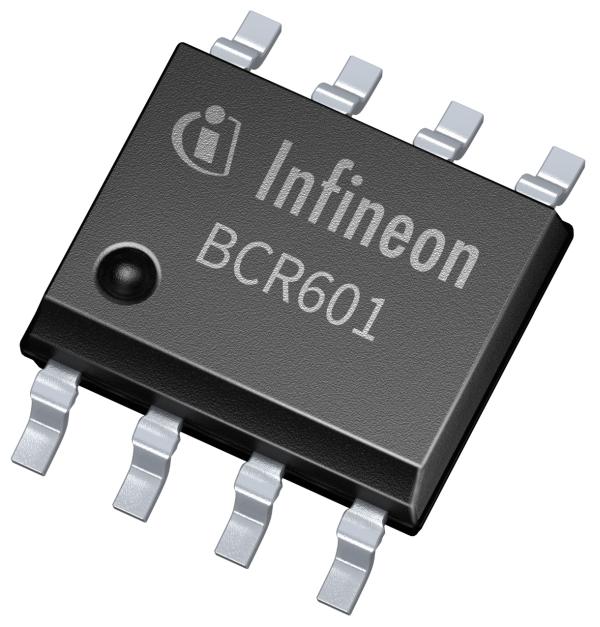
The BCR602 targets dimmable LED applications such as light engines, modules and strips. It has a wide voltage range of up to 60V makes it suitable for 48V designs and DC/DC grids, confirms Infineon.
The supply voltage of both LED controller ICs ranges from 8.0 to 60V up to the SELV limit. Both the BCR601 and BCR602, operate with an external driver transistor, either an NPN bipolar transistors or an N-channel MOSFET to support a wide LED current and power range.
The ICs allow the LED current to be adjusted by resistors as well as dimmed analogue. The BCR602 also accepts digital PWM up to 3.5 kHz and combined dimming.
Both the BCR601 and BCR602 represent an inherent AC ripple suppression, driving a constantly stable LED current to prevent light flicker.
The AHC of the BCR601 allows controlling the output voltage of the primary side converter such as the XDPL8218 flyback controller from Infineon. This architecture helps a linear LED controller to achieve maximum system efficiency by actively adjusting the AC/DC feedback loop to set minimum voltage headroom.
Adjusting the minimum necessary voltage across the pass transistor optimises system efficiency which can normally only be achieved by secondary switched mode device, points out Infineon, to reduce component temperatures and stress. This construction also reduces EMI compared to switched mode supplies in combination with a low bill of materials, adds Infineon. Additionally, the BCR601 features an adjustable over-voltage protection to prevent any damage to the LEDs.
Read more: LINEAR LED CONTROLLER ICS TARGET DIMMABLE LIGHTING APPLICATIONS
- What is the primary function of the BCR601?
The BCR601 provides voltage feedback to the primary side known as active headroom control for cost-effective and power-efficient LED driver applications. - Can the BCR602 support digital PWM dimming?
Yes, the BCR602 accepts digital PWM up to 3.5 kHz and combined dimming for light engines, modules, and strips. - What external components are required for these ICs to operate?
Both ICs operate with an external driver transistor, either an NPN bipolar transistor or an N-channel MOSFET. - How do these ICs prevent light flicker?
Both the BCR601 and BCR602 represent inherent AC ripple suppression to drive a constantly stable LED current. - Does the BCR601 help reduce electromagnetic interference?
Yes, this construction reduces EMI compared to switched mode supplies while maintaining a low bill of materials. - What is the supply voltage range for these controllers?
The supply voltage ranges from 8.0 to 60V up to the SELV limit. - How is the LED current adjusted in these designs?
The LED current can be adjusted by resistors as well as through analog dimming. - Why does the BCR601 architecture improve system efficiency?
It actively adjusts the AC/DC feedback loop to set minimum voltage headroom across the pass transistor.
