
Summary of LED MUSIC VISUALIZER BESPECKLES YOUR BEDROOM
James Best created a massive 900-LED music visualizer mounted on plywood and lumber to display frequency content from audio. Using a Teensy microcontroller with DMA capabilities, the system processes Fourier-transformed music samples in real-time while driving the LEDs via bitstream. The grid was established using blue tape and secured with Gaffers tape after initial adhesive issues.
Parts used in the LED Music Visualizer:
- 900 RGB LEDs (WS2812B)
- Teensy microcontroller
- Plywood
- Lumber
- Blue tape
- Gaffers tape
When it comes to wall-mounted ornamentation, get ready to throw out your throw-rugs and swap them for something that will pop so vividly, you’ll want to get your eyes checked. To get our eyes warmed up and popping, [James Best] has concocted a gargantuan 900-RGB-LED music visualizer to ensure that our bedrooms are bright and blinky on demand.
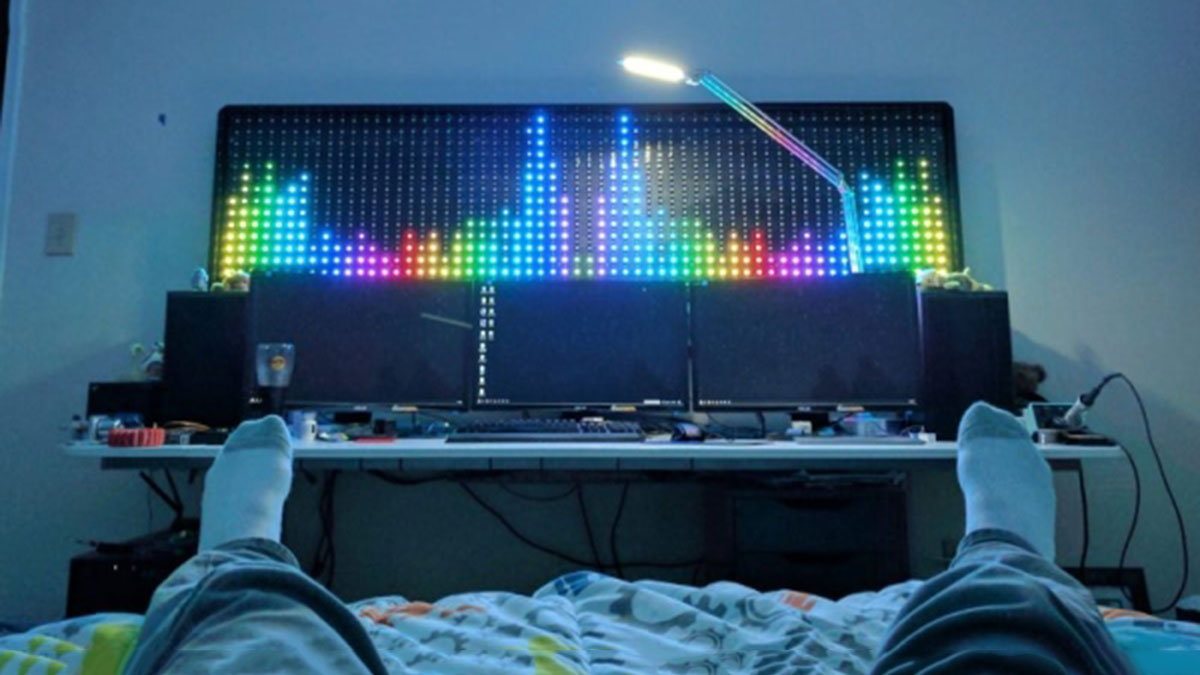
Like any other graduate from that small liberal-arts school in southern California, [James] started prototyping with some good old-fashioned blue tape. Once he had had his grid-spacing established, he set to work on 2-meter-by-0.5-meter wall mounted display from some plywood and lumber. Following some minor adhesive mishaps, James had his grid tacked down with Gaffers tape, and ready for visuals.
Under the hood, a Teensy is leveraging its DMA capabilities to conduct out a bitstream to 900 LEDs. By using the DMA feature and opting for a Teensy over the go-to Arduino, [James] is using the spare CPU cycles to cook out some Fourier-Transformed music samples and display their frequency content.
We’ve covered folks proving the concept of driving oodles of WS2812B LEDs over DMA; it’s great seeing these ideas mature into a fully-featured project that lands on the walll. For more on chatting with WS2812B LEDs over DMA, have a look back into our archive.
Source: LED MUSIC VISUALIZER BESPECKLES YOUR BEDROOM
- What is the main purpose of this project?
To create a wall-mounted ornamentation that displays vivid visuals from music. - How many LEDs are used in the display?
The project uses a total of 900 RGB LEDs. - Why did the creator choose a Teensy over an Arduino?
To leverage DMA capabilities for driving LEDs while freeing up CPU cycles for Fourier-transformed music samples. - What material was used to build the wall-mounted display frame?
Plywood and lumber were used to construct the 2-meter-by-0.5-meter display. - How was the LED grid initially spaced out during prototyping?
Blue tape was used to establish the grid spacing before mounting. - What type of tape was used to tack down the final grid?
Gaffers tape was used after some minor adhesive mishaps occurred. - What signal does the Teensy send to the LEDs?
The Teensy conducts a bitstream to the LEDs using its DMA capabilities. - What kind of data processing happens on the spare CPU cycles?
The system cooks out Fourier-transformed music samples to display their frequency content.
