
Summary of IWAVE SYSTEMS ULTRA-HIGH-PERFORMANCE FPGA PLATFORMS FOR AI/ML ACCELERATED EDGE COMPUTING IN IOT APPLICATIONS
This article discusses leveraging Xilinx Zynq® UltraScale+™MPSoC FPGAs for intelligent edge computing in IoT. It highlights how these platforms enable real-time AI/ML inference with low latency by combining ARM processors and FPGA logic. The solution utilizes Deephi core platforms to accelerate tasks like image recognition and pose detection, offering a flexible architecture for future-proofing edge gateway designs.
Parts used in the Edge Gateway Solution:
- Xilinx Zynq® UltraScale+™MPSoC FPGA modules
- iWave Zynq® UltraScale+™MPSoC SOM
- ARM® multicore processors
- Xilinx FPGA components
- Deephi algorithms
- Xilinx/DeePhi core platforms
- Zynq® UltraScale+™MPSoC development platforms
With the advent of IoT and the proliferation of connected embedded devices, one of the biggest challenges in developing competitive IoT solutions is the ability to bring intelligence at the Edge of the IoT networks. Edge computing is crucial in IoT applications as it paves the way for faster real-time inference by embedding computation capability in on-premise infrastructure resulting in a dramatic improvement in overall system reliability and performance.
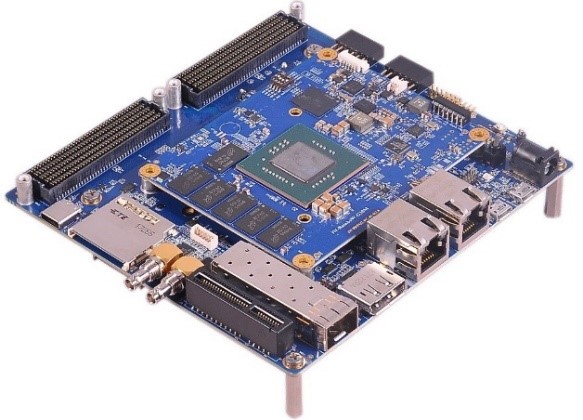
With edge computing increasingly forming the foundation of next-generation secure and connected devices, it is important to highlight the significance played by the hardware accelerators in determining system performance & efficiency and therefore should be considered with utmost importance while developing edge gateway solutions.
Over the years significant advancement in FPGA technology has led to FPGAS becoming mainstream for developing intelligent edge platforms. FPGAs sophisticated performance and adaptability coupled with their ability to deliver the highest throughput at the lowest latency makes them ideal for enabling highly responsive real-time inference at the edge.
At iWave Systems, a leading FPGA design house based in Bangalore, we have expended state of the art Xilinx Zynq® UltraScale+™MPSoC FPGA modules to bring forth intelligence in edge devices using advanced AI/ML accelerations. iWave’s Zynq® UltraScale+™MPSoC FPGA SOM offers versatile hardware accelerations for intuitive deployment of functions such as, image /speech recognition, object /pose detection, etc. and a flexible platform that enables developers to continually refine features and sharpen their competitive edge. Implementing artificial neural networks in FPGAs provides the flexibility to adapt applications with changing standards and end-user demands, which in turn future proofs your designs.
iWave also provides comprehensive Zynq® UltraScale+™MPSoC development platforms for an immediate evaluation of AI/ML applications.
Xilinx/DeePhi core platforms for AI/ML inference in iWave’s Zynq® UltraScale+™MPSoC SOM
The Zynq UltraScale+ MPSoC SOM features an intelligent blend of MPSoC and FPGA functionality in an ARM® + Xilinx FPGA architecture that forms a highly integrated & powerful embedded platform for edge applications. The heterogeneous ARM® multicore processors complement the edge applications with high-performance non-real-time processing such as system boot, peripherals management, server communication, etc., while offloading the FPGA to execute critical real-time tasks using Deephi algorithms.
Deephi core platforms integrate both hardware and software components, presenting a comprehensive framework for AI/ML acceleration in applications such as face recognition, real-time surveillance, image / pose detection, etc. With its industry-leading AI/ML capabilities, the Xilinx/ Deephi core platform allows high-level adaptiveness to various workload characteristics and complement edge applications with ultra-low latency real-time inference.
- Why is edge computing crucial for IoT applications?
It enables faster real-time inference by embedding computation capability in on-premise infrastructure, improving system reliability and performance. - What makes FPGAs ideal for edge platforms?
Their sophisticated performance, adaptability, ability to deliver highest throughput at lowest latency, and support for real-time inference make them ideal. - Which specific FPGA module does iWave Systems use for intelligence in edge devices?
iWave Systems uses state of the art Xilinx Zynq® UltraScale+™MPSoC FPGA modules. - What functions can be deployed using the Zynq® UltraScale+™MPSoC SOM?
It supports intuitive deployment of functions such as image or speech recognition and object or pose detection. - How do ARM® processors complement the FPGA in this architecture?
The ARM® multicore processors handle high-performance non-real-time processing like system boot and peripherals management while offloading critical real-time tasks to the FPGA. - What role do Deephi algorithms play in the system?
Deephi algorithms are executed on the FPGA to perform critical real-time tasks and provide ultra-low latency real-time inference. - What types of applications benefit from the Xilinx/Deephi core platform?
Applications include face recognition, real-time surveillance, and image or pose detection. - How does implementing artificial neural networks in FPGAs help designers?
It provides flexibility to adapt applications with changing standards and end-user demands, which future proofs the designs.
