
Summary of The Internet of Bees: Adding Sensors to Monitor Hive Health
The Digital Beehive project utilizes Wi-Fi to transmit real-time data on weight, humidity, temperature, and battery voltage to SparkFun's Phant service. Developed over nine months in Portland, Oregon, this initiative combines engineering with apiculture expertise to monitor hive health without interfering with beekeeping duties. The system is designed to withstand the 400lb weight of a healthy hive while providing robust field performance.
Parts used in the Digital Beehive:
- Load cell
- Wi-Fi module
- Humidity sensor
- Temperature sensor
- Battery voltage monitor
- SparkFun Phant data channel service
The Digital Beehive uses Wi-Fi to broadcast a beehive’s weight, humidity, temperature, and battery voltage every minute to SparkFun’s data channel service called Phant. The raw data can be seen here but you can view some prettier graphs of the data here on analog.io (sign-in required).
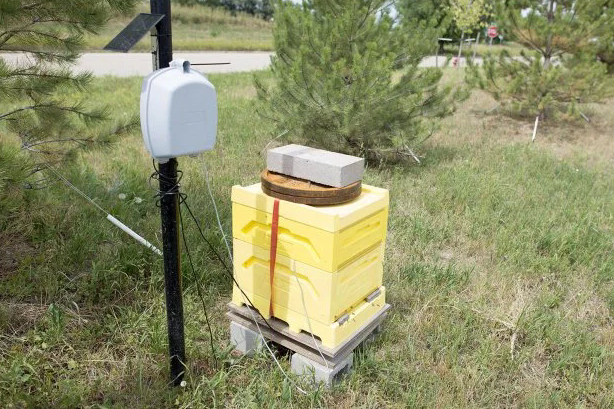
On a visit to Portland, Oregon, last summer my friend mentioned he had always wanted to put a load cell under a beehive to measure the weight of the hive over time. He thought it was a great project for SparkFun and I immediately started thinking how it might be done. Fast forward through 9 months of testing and development and we’ve got live bee data!
First a disclaimer: This is a project that focuses on the technology and the lessons in the field, but I have only scratched the surface of beekeeping (apiculture). SparkFun is fortunate to have a handful of employees who are either beekeepers or related to beekeepers. They were nice enough to do the bee tending, I did the tech. Additionally, I am an engineer so data accuracy is important to me but the interpretation of that data should be left to research scientists. That said, check this out!
A healthy hive can hit 400lbs (180kg), so we need to create a scale that can handle the hive’s maximum weight and also have the robustness to survive in the field.
For More Details: The Internet of Bees: Adding Sensors to Monitor Hive Health
-
How does the Digital Beehive transmit data?
It uses Wi-Fi to broadcast weight, humidity, temperature, and battery voltage every minute to SparkFun’s Phant service. -
What specific metrics are monitored by the system?
The system monitors the beehive's weight, humidity, temperature, and battery voltage. -
Can raw data from the project be viewed publicly?
Yes, raw data can be seen directly, though prettier graphs require signing in to analog.io. -
Who was responsible for tending the bees during the project?
SparkFun employees who are beekeepers or related to beekeepers handled the bee tending. -
What is the maximum weight capacity required for the scale?
A healthy hive can hit 400lbs (180kg), so the scale must handle this maximum weight. -
Where did the initial idea for the project originate?
The idea came from a friend in Portland, Oregon, who wanted to measure hive weight over time using a load cell. -
Who should interpret the data collected by the sensors?
Data interpretation should be left to research scientists as the author has only scratched the surface of apiculture.
