
Summary of HACKADAY PRIZE 2023: UNIVERSAL TENSILE TESTING MACHINE
Universal Tensile Testing Machine built by Xieshi Zhang: an affordable, DIY tensile/compression tester costing about $300. It uses a NEMA 17 stepper driving a lead screw on aluminium extrusion with 3D-printed fixtures, an Arduino reading a tensile strain gauge, and can apply up to 1 kN. Suitable for testing 3D-printed parts, filaments, and infill types as a compact version of industrial tensile testers.
Parts used in the Universal Tensile Testing Machine:
- Arduino
- Tensile strain gauge
- NEMA 17 stepper motor
- Lead screw
- 3D-printed test fixture components
- Aluminium extrusion frame
- Power supply for stepper and electronics
- Motor driver for NEMA 17
- Fasteners and mounting hardware
- Specimen grips for tensile/compression testing
Material testing is important in big industry, where manufacturers must be able to trust the properties of the raw materials they’re using. The rest of us generally take a supplier’s word for it that they’re giving us what we’ve paid for. However, you could always take on material testing yourself with the Universal Tensile Testing Machine from [Xieshi Zhang].
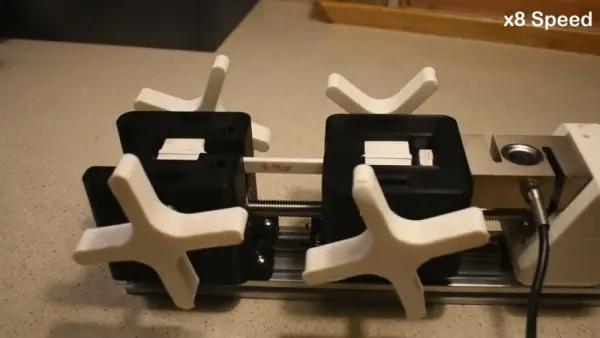
Unlike a six-figure industrial machine, this build is much more affordable, costing on the order of $300 to build. It uses an Arduino to read a tensile strain gauge, and is capable of applying up to a kilonewton of force. To achieve this, it uses a NEMA 17 stepper motor driving a lead screw to apply tensile strain or compression to the specimen under test. The test fixture is assembled from 3D-printed components, and built on top of a piece of aluminium extrusion.
Fundamentally, it’s a smaller version of a machine most engineering undergraduates will see in a materials lab experiment. It could be highly useful for anyone wanting to experiment with 3D printed structures; it would be more than capable of testing various filaments and infill types for their tensile and compression performance. Video after the break.
Source: HACKADAY PRIZE 2023: UNIVERSAL TENSILE TESTING MACHINE
- What is the approximate cost to build the Universal Tensile Testing Machine?
The article states it costs on the order of $300 to build. - What controller is used to read the strain gauge?
An Arduino is used to read the tensile strain gauge. - What type of motor drives the machine?
It uses a NEMA 17 stepper motor driving a lead screw. - How much force can the machine apply?
The build is capable of applying up to a kilonewton of force. - What materials are used for the test fixture?
The test fixture is assembled from 3D-printed components. - What is the structural frame built on?
The machine is built on top of a piece of aluminium extrusion. - Can this machine test 3D-printed filaments and infill types?
The article says it would be more than capable of testing various filaments and infill types for tensile and compression performance. - Is this machine comparable to industrial tensile testers?
Fundamentally it is a smaller version of the machines used in materials labs, offering similar test capabilities at lower cost.
