
Summary of Fobble – A general purpose Wireless Breakout Board!
This article introduces Fobble, a 50mm x 50mm general-purpose wireless carrier board featuring a resident RFduino BLE module with an ARM Cortex M0 processor. Designed for hobbyists, it supports various applications like key fobs, wearable pendants, and data displays. The board includes detachable sections to create compact devices, side prototyping areas, and flexible headers for adding modules like ESP8266 or RFM69 via X-Bee footprints.
Parts used in the Fobble:
- RFduino Bluetooth Low Energy Module
- ARM Cortex M0 processor
- 2 layer PCB (50 x 50 mm)
- X-Bee footprint
- 0.1" breakout headers
- Push button switches
- RGB 0505 LED footprint
- Detachable power and programmer section
- Detachable side panels
- 8 pin header
- 1.3" OLED display
- 20mm coin cell or flat Li Po cell
- Micro-USB connector
- Side Prototyping areas
- 7 pin header
- 5 pin header
This week I have been working on another of my standard footprint 50mm x 50mm boards – it is a general purpose wireless module carrier board:- Fobble. That’s a BLE Fob – for anyone who misses the pun.
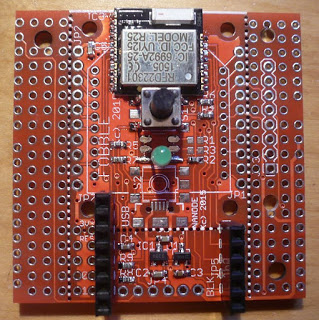
In the last few weeks there have been a number of applications arise – that could easily be addressed with an easy to use, generic wireless platform. These have included keyfob or pendant applications – requiring a small coin cell powered board – to a generic wireless board that can be stacked to one of the processor boards to provide wireless connectivity.
So after a week of head-scratching, I have come up with a small board, which at least meets the requirements of the development phase of the project – once again a useful, flexible dev-board that hobbyists can experiment with.
As can be seen from the above picture it contains a number of key features:
- A resident RFduino Bluetooth Low Energy Module with ARM Cortex M0 processor
- 2 layer pcb 50 x 50 mm format- with extended Arduino headers pin-out
- An X-Bee footprint – with 0.1″ breakout headers – to add your own wireless module
- Two push button switches – only 1 populated shown
- Footprint for RGB 0505 LED
- Detachable power and programmer section
- Detachable side panels – to make 38 x 32 mm BLE Key Fob
- 8 pin header to accept 1.3″ OLED display
- 20mm coin cell or flat Li Po cell power – on rear of Fob pcb
- Micro – USB connector for recharging Li Po
- Side Prototyping areas – perforated in 0.1″ matrix
- 7 pin and 5 pin headers to accept any RFduino accessory shields – for development work
Some applications include:
- A low power wireless data display using BLE and either OLED or e-ink display.
- A BLE key fob, or wearable pendant with 2 user buttons and an RGB LED
- A bridge between BLE and low power 433Hz or WiFi
- As a wireless shield for an Arduino compatible device
- As a general purpose Experimenter’s BLE dev-board.
The other unique feature about Fobble, is that it has it’s own native ARM M0 and Bluetooth Low Energy module, and can act as a bridge between Bluetooth, and any other wireless module that you may wish to use.
It can accept any wireless module that offers an XBee footprint – or a wireless daughter module of your own making – pinned out to 2, 10 pin headers on 1.1″ centres. This simple scheme offers the most flexibility. So you can add an ESP8266 on an X-Bee format carrier, or similarly an RFM69.
Fobble is pin compatible with the standard Arduino header footprint, and will also accept a 3.3V FTDI cable for programming.
Read more: Fobble – A general purpose Wireless Breakout Board!
- What is the primary function of the Fobble board?
It serves as a general purpose wireless module carrier board for development and experimentation. - Can the Fobble board be used to create a key fob?
Yes, detachable side panels allow the board to be configured into a 38 x 32 mm BLE Key Fob. - Does the board support external wireless modules?
Yes, it has an X-Bee footprint to accept modules like ESP8266 or RFM69. - How is the Fobble board powered?
It accepts a 20mm coin cell or flat Li Po cell on the rear, with Micro-USB for recharging. - Is the Fobble board compatible with Arduino shields?
Yes, it features 7 pin and 5 pin headers to accept any RFduino accessory shields. - What display options are supported by the board?
The board includes an 8 pin header to accept a 1.3" OLED display. - Can the Fobble act as a bridge between different wireless protocols?
Yes, it can act as a bridge between Bluetooth and other wireless modules like 433Hz or WiFi. - How is the board programmed?
It accepts a 3.3V FTDI cable for programming and is pin compatible with standard Arduino headers.
