
Summary of FFTs and oscilloscopes: A practical guide
This article explains how to effectively use Fast Fourier Transform (FFT) analysis on digital oscilloscopes, transforming time-domain data into frequency-domain views. It highlights FFT's ability to reveal signal bandwidths and spectral distributions that are difficult to identify in time-domain traces alone, using an amplitude-modulated carrier as a practical example.
Parts used in the FFT Analysis Project:
- Digital Oscilloscope
- Fast Fourier Transform (FFT) Algorithm
- Discrete Fourier Transform (DFT)
- Amplitude-Modulated Carrier Signal
- Trapezoidal Pulse Modulation Function
- Cursors
The FFT (Fast Fourier Transform) first appeared when microprocessors entered commercial design in the 1970s. Today almost every oscilloscope from high-priced laboratory models to the lowest-priced hobby models offer FFT analysis. The FFT is a powerful tool, but using it effectively requires some study. I’ll show you how to set up and use the FFT effectively. We’ll skip the technical description of the FFT, because its already implemented in the instruments. Instead I’ll focus on the practical aspect of using this great tool.
The FFT is an algorithm that reduces the calculation time of the DFT (Discrete Fourier Transform), an analysis tool that lets you view acquired time domain (amplitude vs. time) data in the frequency domain (amplitude and phase vs. frequency). In essence, the FFT adds spectrum analysis to a digital oscilloscope.
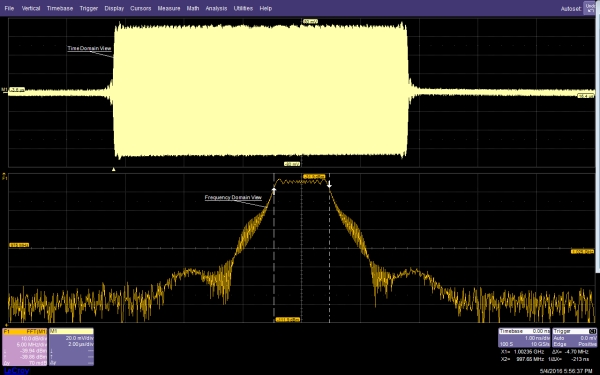
If you look at upper trace in Figure 1, you’ll see an amplitude-modulated carrier that uses a trapezoidal pulse as the modulation function. If you look at the time-domain view in Fig. 1 and I ask you to tell me the bandwidth of the signal, you’d have a hard time. But take the FFT of this signal and you get another point of view. The signal has a linearly swept frequency and the bandwidth, marked by the cursors, is 4.7 MHz. That’s how the FFT adds to the capability of the oscilloscope, it provides another point of view for the same data.
Figure 1. The time domain view in the top grid shows a pulse modulated RF carrier while the frequency domain view in the lower grid shows a uniform distribution of the carrier frequency between 997 MHz and 1002 MHz.
FFT frequency span and resolution bandwidth
In your earliest circuits course, you learned the frequency (frequency domain) of a periodic signal is the reciprocal of the period (time domain). That same relationship appears throughout the FFT setup.
Read more: FFTs and oscilloscopes: A practical guide
- When did the FFT first appear in commercial design?
The FFT first appeared when microprocessors entered commercial design in the 1970s. - Can almost every oscilloscope offer FFT analysis today?
Yes, almost every oscilloscope from high-priced laboratory models to the lowest-priced hobby models offers FFT analysis. - What is the primary function of the FFT algorithm?
The FFT reduces the calculation time of the DFT to let you view acquired time domain data in the frequency domain. - Does the FFT add spectrum analysis to a digital oscilloscope?
Yes, the FFT adds spectrum analysis to a digital oscilloscope by providing another point of view for the same data. - How does the FFT help determine signal bandwidth?
The FFT allows you to see a uniform distribution of frequencies where cursors can mark the bandwidth, such as 4.7 MHz in the example. - What relationship exists between frequency and period in FFT setup?
The frequency of a periodic signal is the reciprocal of the period, a relationship that appears throughout the FFT setup. - Why should one focus on the practical aspect of using the FFT?
Focusing on the practical aspect is necessary because using the FFT effectively requires some study.
