
Summary of ESP8266 + I2S = Software-based 10-Base-T Ethernet Driver
This article describes "espthernet," a software-based 10-Base-T Ethernet driver for the ESP8266 using I2S pins. It handles Manchester encoding/decoding and borrows TCP/IP stacks from avrcraft. The system requires specific hardware streams and uses a web interface for packet testing and demanchestration table generation.
Parts used in espthernet:
- ESP8266 Microcontroller
- I2S Pins (two pins)
- Software Driver (manchesterate.c and related files)
- Frontend code (i2sduplex.c)
- Network compatibility layer (net_compat.c)
- avrcraft TCP/IP stack components (IP, ARP, UDP, TCP)
- Web Interface tools
- Demanchestration table (demanchestrate_table.h)
espthernet
It’s pronounced “e-s-peethernet” – a party trick, not a legitimate engineering solution.
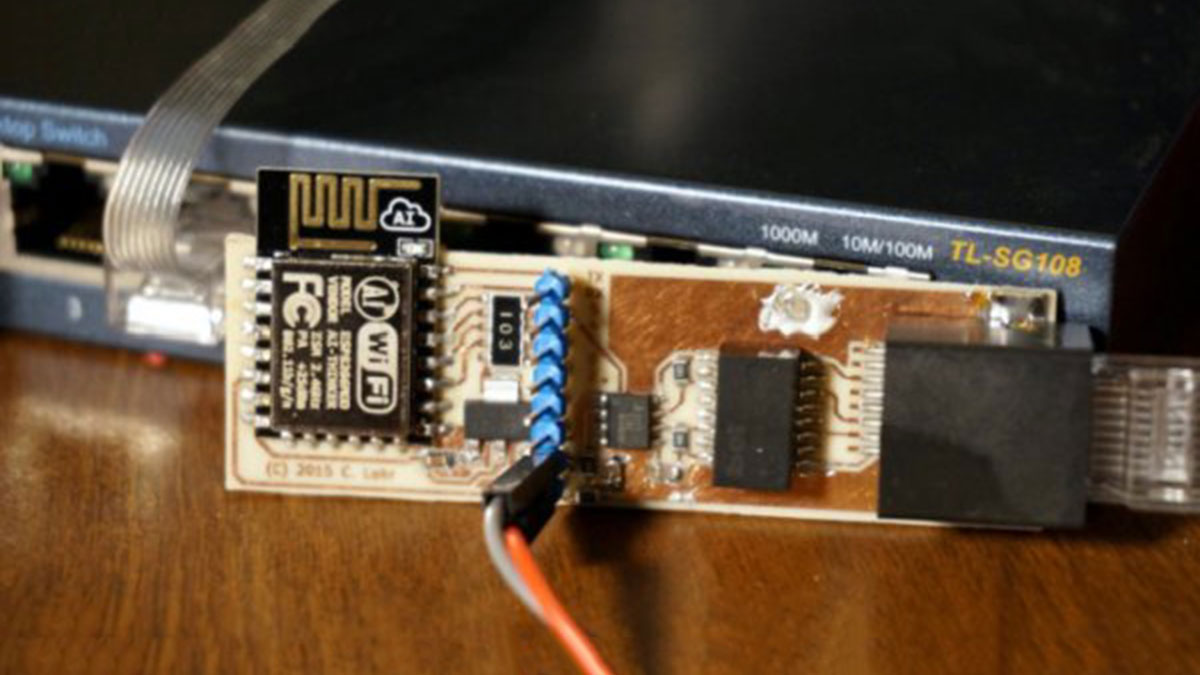
ESP8266 + I2S = Software-based 10-Base-T Ethernet Driver
For a detailed overview of how this project works, please see the Hackaday article. For a rough idea of what’s going on,
checkout the youtube video:
Overall Discussion
This is a relatively unreliable and coincidentally functional ESP8266 Ethernet driver. It only uses two pins on the ESP, the I2S pins, but does provide Ethernet. It does all its own manchester encoding/decoding, framing, FCS, etc. It mimics the ENC424J600 stack found in avrcraft and borrows the IP, ARP, UDP and TCP stacks from that project, too.
This product was created by Charles Lohr, but, will likely fall out of support by original author quickly. Additional contributers would be welcome.
The frontend i2sduplex.c is what takes the bits off wire and calls a callback in an interrupt with raw 32-bit words of what came in from the wire. It also accepts buffers to send raw bits out on the wire.
Though designed for the ESP8266 should be relatively portable, as most of the code is limited to manchestrate.c and related files. Since it is designed to operate at full duplex, it is expecting a 40MHz-in, and 40MHz-out stream. This stream mus be biased toward 0’s instead of 1’s since at 40MHz-in there are ambiguous bit patterns if you don’t bias. This takes on raw on-wire bits and puts out ethernet frames – or accepts frames and outputs raw on-wire bits.
From there, we can check the FCS and process the packets in a consistent way and have a way of interacting with buffers. net_compat.c is what handles all of that. The interface it provides mimics the ENC424J600 and is what is used in avrcraft. The reason I use that interface on so many projects is because the style of memory access and use makes it require less buffers and less copying than stacks like lwip.
For the user layer, this system just borrows everything from avrcraft, including the http server! You will notice that it’s a little awkward since it’s designed to operate with either the TCP/IP stack from Espressif OR the avrcraft TCP/IP server. It would be really cool if we could figure out some way to have consistent entry.
The Web Interface
There is a web interface that gets put on the ESPs with a “make” step from the “web” directory. It pushes the webpage to the ESP. The webpage does not need to live on the ESP, itself, it can be viewed independent of one, it just only supports the “Load Test Packet” feature in “Last Packet” version on github.io.
The webpage is what is used to look at packets, create the demanchestration table, demanchestrate_table.h and test the table on new data. This was needed considering how complicated the decoding process is. Without testing on data, a lot of data, coming up with a robust algorithm was almost impossible!!! One other feature in the web interface is you can click on the 1’s and 0’s and turn them on and off to see how the system decodes those packets.
Read more: ESP8266 + I2S = Software-based 10-Base-T Ethernet Driver
-
How does espthernet handle data transmission?
The frontend i2sduplex.c takes bits off the wire calling a callback in an interrupt with raw 32-bit words and accepts buffers to send raw bits out. -
What is the required clock speed for the data stream?
The system expects a 40MHz-in and 40MHz-out stream to operate at full duplex. -
Why must the data stream be biased toward zeros?
Biasing toward zeros is necessary because there are ambiguous bit patterns at 40MHz-in if this bias is not applied. -
Which TCP/IP stack does this project borrow from?
The project borrows IP, ARP, UDP, and TCP stacks from the avrcraft project. -
What function does net_compat.c serve?
net_compat.c handles FCS checking, processes packets consistently, and provides an interface mimicking the ENC424J600. -
How can users test the decoding algorithm?
Users can click on the ones and zeros in the web interface to turn them on and off to see how the system decodes those packets. -
Where is the webpage for the web interface hosted?
The webpage does not need to live on the ESP itself and can be viewed independently, though the Load Test Packet feature relies on the github.io version. -
Is this solution considered reliable by engineering standards?
No, it is described as a relatively unreliable and coincidentally functional driver that is more of a party trick than a legitimate engineering solution.
