
Summary of Escape Room Decoder Box
This article details the creation of an educational Escape Room Decoder Box, a project designed to engage students in learning through interactive gameplay. The device features configurable timers, automated clues, and sound effects. It utilizes an Arduino Nano, keypad, LCD screen, and various electronic components housed within a 3D-printed enclosure. The guide covers preparing the hardware by embedding knurled nuts into the plastic case and soldering headers onto modules before assembly.
Parts used in the Escape Room Decoder Box:
- 4x Bolt M3 25mm
- 3x Bolt M3 14mm
- 4x Bolt M3 6mm
- 4x M3 Standoff 6mm
- 5x Lock Nut M3
- 4x Knurled Nut M3
- 3AAA Battery holder with leads
- Key Switch
- Dupont 2-way crimp connector
- 9x Jumper Wires (F-F) 20cm
- 1x 10K Trimpot
- 1x Arduino Nano
- Speaker
- LCD Screen
- Keypad
- PCB
- 2x 7Way Single IDC Header
- 1x 7Way Dual IDC Header
- 3D Printed Enclosure
- 3D Printed Keypad Bracket
- 3D Printed or lasercut LCD bracket
- 3D Printed or lasercut faceplate
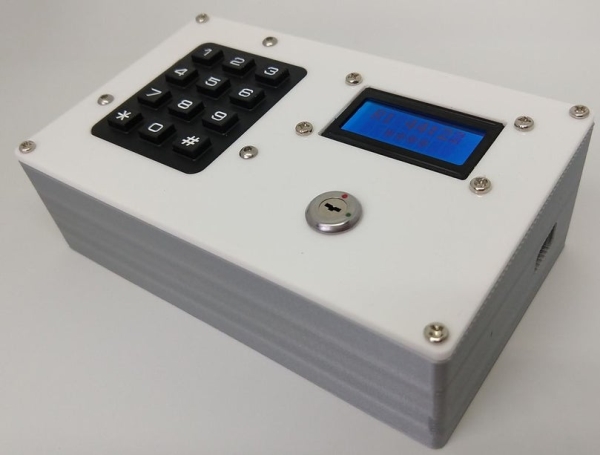
Escape Rooms are awesomely fun activities which are highly engaging and great for teamwork.
Have you ever thought about creating your own Escape Room? Well with this decoder box you can be well on your way! Even better have you thought about using escape rooms in education? We have and students love using them to learn, revise and engage with the material.
This escape room decoder has the following features:
- 3 Rounds of codes with arbitrary length (1-8 digits)
- Configurable count-down timer
- Automated clue delivery (every 5 minutes)
- Configurable wrong-answer penalties
- In-game sound effects
Supplies:
To complete this project you will need the following parts:
Hardware:
- 4x Bolt M3 25mm
- 3x Bolt M3 14mm
- 4x Bolt M3 6mm
- 4x M3 Standoff 6mm
- 5x Lock Nut M3
- 4x Knurled Nut M3
- 3AAA Battery holder with leads
- Key Switch
- Dupont 2-way crimp connector (for battery holder)
- 9x Jumper Wires (F-F) 20cm
Electronics:
- 1x 10K Trimpot
- 1x Arduino Nano
- Speaker
- LCD Screen
- Keypad
- PCB
- 2x 7Way Single IDC Header
- 1x 7Way Dual IDC Header
Fabricated Parts (3D Printed/Laser Cut):
- 3D Printed Enclosure
- 3D Printed Keypad Bracket
- 3D Printed or lasercut LCD bracket
- 3D Printed or lasercut faceplate
Step 1: Preparing the Decoder Box
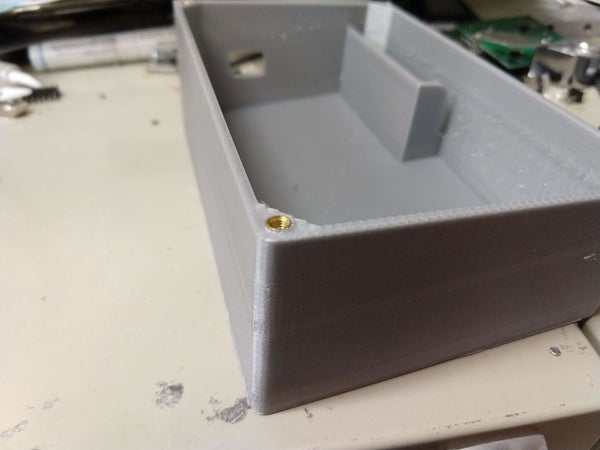
The enclosure for this project is 3D printed so you will need access to 3D printing facilities or will need to purchase a kit.
After the enclosure is 3D printed the knurled nuts will need to be inserted into each of the screwholes. These nuts allow screws to be easily tightened and loosened multiple times (the 3D print would wear out too quickly).
To insert the nuts use a soldering iron and apply gentle pressure to the knurled nut. As the nut heats up it will melt and embed itself in the plastic as shown in the pictures.
Step 2: Soldering the Modules
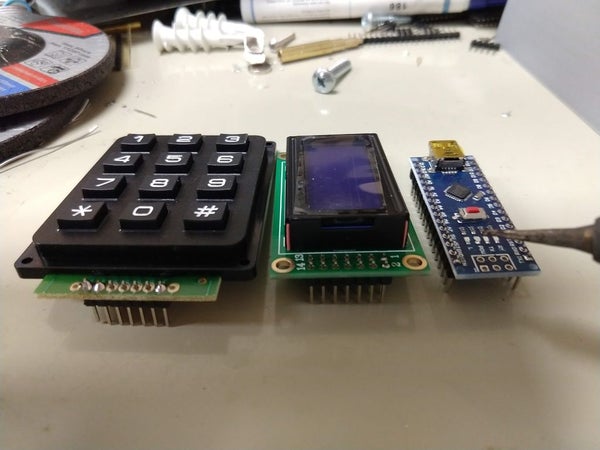
The keypad, LCD and Arduino Nano all need to have headers soldered onto them.
Ensure you solder the headers onto the correct side of the board as shown in the photographs.
Read more: Escape Room Decoder Box
- What are the main features of this escape room decoder?
The decoder includes 3 rounds of codes with arbitrary length, a configurable countdown timer, automated clue delivery every 5 minutes, configurable wrong-answer penalties, and in-game sound effects. - How can I use this project in education?
Students love using these escape rooms to learn, revise, and engage with material. - What is the purpose of the knurled nuts in the enclosure?
These nuts allow screws to be easily tightened and loosened multiple times without wearing out the 3D print. - How do you install the knurled nuts into the 3D printed enclosure?
You insert them using a soldering iron and apply gentle pressure so the heat melts the nut into the plastic. - Which electronic modules require headers to be soldered?
The keypad, LCD, and Arduino Nano all need headers soldered onto them. - Where should the headers be soldered on the boards?
Headers must be soldered onto the correct side of the board as shown in the project photographs. - What type of power source does the decoder box use?
The project uses a 3AAA Battery holder with leads. - Can the code length be customized for different difficulty levels?
Yes, the system supports 3 rounds of codes with an arbitrary length ranging from 1 to 8 digits.
