
Summary of EMB-2610 Pico-ITX SBC Runs Linux and comes with Touch Panel
Estone Technology's EMB-2610 is a 100x72mm Pico-ITX single-board computer featuring an Intel Atom x5-Z8350 quad-core processor. It supports Windows 10, Linux, and Android, offering 2GB or 4GB DDR3L RAM and up to 64GB NAND flash storage. The board includes micro-HDMI, LVDS/eDP/MIPI-DSI display interfaces, WiFi/Bluetooth, GbE with optional PoE via an add-on board, and a 40-pin expansion header for custom modules like GPIO and PCIe.
Parts used in the EMB-2610 Pico-ITX SBC:
- Intel Atom x5-Z8350 SoC
- DDR3L RAM (2GB or 4GB)
- NAND Flash (up to 64GB)
- MicroSD Slot
- WiFi/Bluetooth Module
- Gigabit Ethernet Port
- Power-over-Ethernet Add-on Board
- Micro-HDMI Port
- LVDS, eDP, or MIPI-DSI Display Interfaces
- I2C Capacitive Touch Controller
- MIPI-CSI Interface
- Audio Header
- USB 3.0 and 2.0 Host Ports
- Micro-USB Port
- Serial, GPIO, and USB Headers
- 40-Pin Expansion Header
- Optional Estone Modules (GPIO, Front Panel, PCIe)
Ohio based company, Estone Technology (AKA Habey) has updated the product page for the new EMB-2610 Pico-ITX SBC. The EMB-2610 follows earlier Habey Pico-ITX SBCs such as last year’s i.MX6 UL powered EMB-2200 and i.MX6 based EMB-2230. This time Estone has used a 14nm Intel Atom SoC. Rather than going with Apollo Lake, they used the quad-core, 1.92GHz Atom x5-Z8350 from the Cherry Trail family that tried but failed to win market share in Android phones.
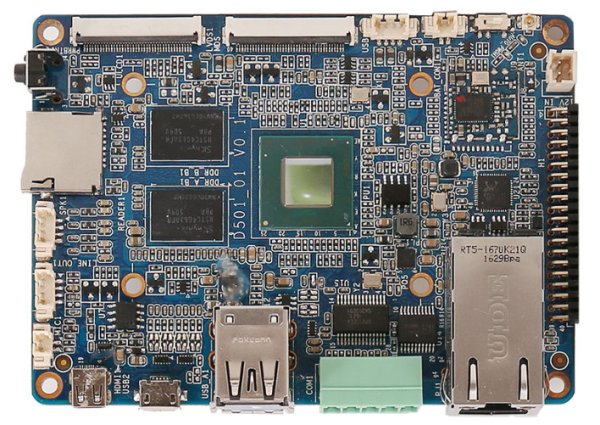
The Atom x5-Z8350 is the same SoC used by Aaeon’s UP Core. Like the UP Core, the 100 x 72mm, Pico-ITX form factor EMB-2610 supports Windows 10 and 10 IoT in addition to Android and various Linux distributions. The new EMB-2610 is available with 2GB or 4GB of DDR3L RAM and comes with a microSD slot and up to or 64GB NAND flash. WiFi/Bluetooth connectivity is available, as well as a GbE port with optional Power-over-Ethernet (PoE), enabled via an add-on board.
The EMB-2610 is further enhanced with a micro-HDMI port, as well as LVDS, eDP, or MIPI-DSI, all supported via a touch controller. There’s also an audio header and MIPI-CSI. USB 3.0 and 2.0 host ports are ready along with a micro-USB port, and there’s a smattering of serial, GPIO, and USB headers.
This board uses the same 40-pin expansion header found on the i.MX6-based EMB-2230. The connector, which supports optional Estone modules for 8x GPIO, front panel controls, PCIe, and PoE, is available with header specs and diagrams to make it easy to develop custom expansions. Although, the use of the connector PCIe disables the GbE port.
Specification summary for EMB-2610:
- Processor : Intel Atom x5-Z8350 (4x Cherry Trail cores @ 1.44GHz / 1.84GHz burst); Intel HD 400 Graphics (200MHz/500MHz)
- Memory & Storage:
- 2GB or 4GB DDR3L
- 32GB or 64GB NAND flash
- MicroSD slot
- Wireless: WiFi/Bluetooth module
- Networking: GbE port with optional PoE
- Media I/O:
- Micro-HDMI port at 1920 x 1080
- 24-bit LVDS, eDP, or MIPI-DSI at 1920 x 1200
- An I2C capacitive touch controller
- MIPI-CSI
- Audio header with line-out, mic-in, headphone, 10W speaker
Read more: EMB-2610 Pico-ITX SBC Runs Linux and comes with Touch Panel
- What processor does the EMB-2610 use?
The board uses a quad-core 1.92GHz Intel Atom x5-Z8350 from the Cherry Trail family. - Can I run Windows 10 on this board?
Yes, the EMB-2610 supports Windows 10, 10 IoT, Android, and various Linux distributions. - How much memory can the system support?
The device is available with either 2GB or 4GB of DDR3L RAM. - Does the board include wireless connectivity?
Yes, it comes equipped with a WiFi and Bluetooth module. - Is Power-over-Ethernet supported natively?
No, PoE requires an optional add-on board connected to the GbE port. - What display options are available?
It features a micro-HDMI port and supports 24-bit LVDS, eDP, or MIPI-DSI via a touch controller. - Can I expand the board with custom modules?
Yes, a 40-pin expansion header supports optional Estone modules for GPIO, front panel controls, and PCIe. - What happens if I enable the PCIe module?
Using the connector for PCIe disables the GbE port.
