
Summary of DIY SILICON PHOTODIODE PARTICLE DETECTOR DIRECTLY FROM CERN
The article describes an open-source DIY silicon photodiode particle detector that distinguishes alphas and electrons and measures energies from 33 keV to 8 MeV. It is light‑shielded (e.g., inside a candy tin), connects to laptop or smartphone microphone/headset inputs, and costs about €20 in parts. Construction files and software are available under the CERN Open Hardware License on the project website and kitspace. A measurement of an old uranium‑glazed ceramic pendant showed beta electrons and alpha lines around 3–4 MeV, with some higher-energy polonium peaks absent due to purified uranium glaze.
Parts used in the DIY Silicon Photodiode Particle Detector:
- Silicon photodiode
- Custom circuit board (project PCB)
- Electronic components for amplifier and signal conditioning (resistors, capacitors, op amp/transistor components)
- Power supply components
- Light-tight enclosure (e.g., candy tin box)
- Connectors for audio output (microphone/headset jack)
- Mounting hardware
- USB or smartphone-compatible audio cable
- Software/firmware from project website
Silicon detectors are widely used in particle and nuclear physics for measuring ionizing radiation. This Do-It-Yourself project allows making a low-cost particle detector from scratch using silicon photodiodes.
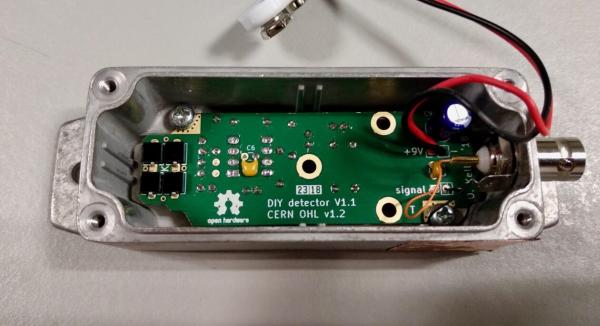
It can distinguish different particle types (alpha particles and electrons) and measures their energy between 33 keV and 8 MeV. The detector must be shielded from light and is, therefore, best mounted inside your favorite candy tin box. The signal output can be directly connected with microphone or headset inputs of regular laptops and smartphones.
The DIY particle detector is open source science hardware, released under the CERN open hardware license. Construction details and software for undertaking measurements can be found on the corresponding project website. The circuit board and electronic parts (~20 EUR) can be easily procured via kitspace, an open hardware design repository.
Measurement of an old ceramic pendant
For the measurement shown below, an old ceramic pendant from the Majolika ceramics manufacture in Karlsruhe, Germany, was put right below the silicon detector. The energy spectrum shows a lot of electrons from beta decays as well as two characteristic alpha energy lines in the 3 to 4 MeV range.
By comparing this measurement with the energy spectrum from a small uranium stone (c.f. article, figure 9), it can be concluded that several higher energy alpha lines are missing. In particular, the two peaks of polonium isotopes on the very right are not present. This can be explained by the fact, that uranium-based ceramic paint, so-called uranium glaze, was typically produced from chemically purified uranium.
Read more: DIY SILICON PHOTODIODE PARTICLE DETECTOR DIRECTLY FROM CERN
- What particle types can the detector distinguish?
The detector can distinguish alpha particles and electrons based on their energy signals. - What energy range can the detector measure?
The detector measures particle energies between 33 keV and 8 MeV. - How should the detector be shielded from light?
The detector must be light-shielded and is best mounted inside a candy tin box or similar enclosure. - Can the detector connect to a laptop or smartphone?
Yes, the signal output can be connected directly to microphone or headset inputs of regular laptops and smartphones. - Is the design open source and under what license?
Yes, it is open source hardware released under the CERN Open Hardware License. - Where can construction details and software be found?
Construction details and software are available on the project website and via kitspace. - How much do the circuit board and electronic parts cost?
The circuit board and electronic parts cost approximately 20 EUR. - What did the measurement of the ceramic pendant reveal?
The measurement showed many beta electrons and two characteristic alpha energy lines in the 3 to 4 MeV range, with higher-energy polonium peaks absent. - Why were the polonium peaks absent in the ceramic pendant measurement?
The article explains the uranium glaze was typically produced from chemically purified uranium, which explains the missing polonium peaks.
