
Summary of COUNTER-STRIKE GETS THE RGB LED TREATMENT
This article details a project where Hans Peter created a real-time lighting system for Counter-Strike: Global Offensive sessions. By utilizing Valve's game state API, an HTTP server analyzes game data and sends serial commands to an Arduino. The Arduino then controls WS2812B LEDs to display visual cues for game events like wins, losses, and bomb threats. For the bomb sequence, the creator manually synchronized LED flashing with recorded audio beeps due to API limitations.
Parts used in the CS:GO RGB Lighting Project:
- Counter-Strike: Global Offensive client
- HTTP server (Node.js based)
- Arduino microcontroller
- WS2812B LEDs
- Audacity software
- Audio recording of bomb arming sequence
Inspired by the over-the-top stage lighting and pyrotechnics used during e-sport events, [Hans Peter] set out to develop a scaled-down version (minus the flames) for his personal Counter-Strike: Global Offensive sessions. It might seem like pulling something like this off would involve hacking the game engine, but as it turns out, Valve was kind enough to implement a game state API that made it relatively easy.
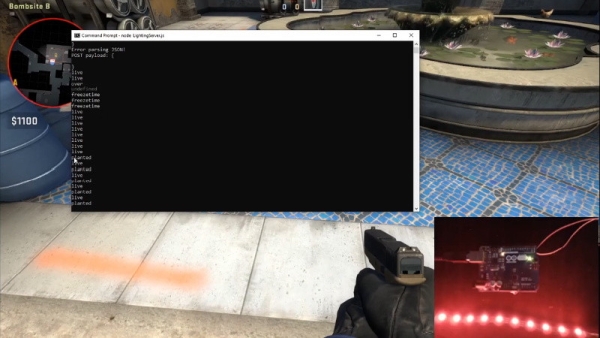
According to the documentation, the CS:GO client can be configured to send out state information to a HTTP server at regular intervals. It even provided example code for implementing a simple state server in Node.js, which [Hans] adapted for this project by adding some conditional statements that analyze the status of the current game.
These functions fire off serial commands to the attached Arduino, which in turn controls the WS2812B LEDs. The Arduino code takes the information provided by the HTTP server and breaks that down into various lighting routines for different conditions such as wins and losses. But things really kick into gear when a bomb is active.
[Hans] wanted to synchronize the flashing LEDs with the beeping sound the bomb makes in the game, but the API doesn’t provide granular enough data. So he recorded the audio of the bomb arming sequence, used Audacity to precisely time the beeps, and implemented the sequence in his Arduino code. In the video after the break you can see that the synchronization isn’t perfect, but it’s certainly close enough to get the point across in the heat of battle.
With the special place that Counter-Strike occupies in the hearts of hackers and gamers alike, it’s little surprise people are still finding unique ways to experience the game.
Source: COUNTER-STRIKE GETS THE RGB LED TREATMENT
- How did the creator access game state information?
The creator utilized the built-in game state API implemented by Valve that allows the client to send state data to an HTTP server. - What programming language was used for the state server?
The example code provided by Valve documentation is written in Node.js, which the creator adapted for this project. - Which type of LEDs are controlled by the Arduino?
The Arduino controls WS2812B LEDs to create various lighting routines. - Why was manual synchronization needed for the bomb sequence?
The API does not provide granular enough data to directly synchronize the LEDs with the in-game bomb sound. - What tool was used to time the bomb beeps?
The creator used Audacity to precisely time the recorded audio of the bomb arming sequence. - Can this project be done without hacking the game engine?
Yes, the project uses the official API rather than hacking the game engine to achieve the lighting effects. - What specific game conditions trigger different lighting routines?
The system creates lighting routines for conditions such as wins, losses, and when a bomb is active. - Is the LED synchronization with the bomb sound perfect?
No, the synchronization is not perfect but is close enough to be effective during gameplay.
