
Summary of Compact Module regulator is for use with FPGAs, GPUs and ASICs
The LTM4646 is a compact dual 10A or single 20A step-down µModule PoL regulator designed for PCIe boards, cloud systems, and medical equipment. It integrates inductors, MOSFETs, and controllers into a small BGA package, reducing solution size by over 25% compared to previous models. Key features include high efficiency (86%), remote sensing for voltage drop compensation, selectable feedback loops, and programmable switching frequencies up to 1.3MHz, making it ideal for powering FPGAs, ASICs, and GPUs.
Parts used in the LTM4646 Project:
- Inductors
- MOSFETs
- DC/DC controller
- Supporting components
- Onboard remote sense amplifiers
- One resistor for frequency programming
Designed for use in PCIe boards, communications infrastructure, cloud computing-based systems, medical, industrial, and test and measurement equipment, the LTM4646 is a dual 10A or single 20A output, step-down µModule PoL regulator from 5.0 or 12V input supply rails. It targets the PCB area constraints of densely populated system boards to power low voltage and high current devices such as FPGAs, ASICs, microprocessors and GPUs, says Analog Devices.
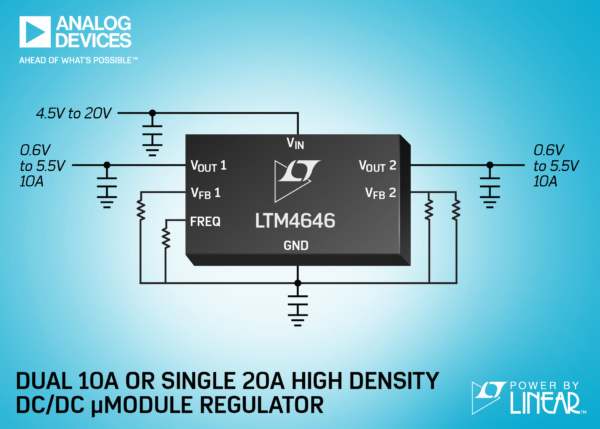
The LTM4646 includes inductors, MOSFETs, a DC/DC controller and supporting components, and is housed in a 11.25 x 15 x 5.01mm BGA package. Compared to the previous two single 10A output module solutions, the LTM4646 reduces the solution size of more than 25 per cent, says Analog Devices.
Total output voltage DC accuracy is guaranteed at ±1.5 per cent over line, load and temperature (-40 to +125 degree C). The onboard remote sense amplifiers on both outputs compensate for voltage drop caused by trace impedance of the PC board due to large load currents. Internal or external feedback loop compensation is selectable, enabling users to optimise loop stability and transient performance while minimising the number of output capacitors.
Peak efficiency at 12VIN to 1.0VOUT is 86 per cent. With 200LFM air flow, the LTM4646 delivers a full 20A continuously up to 85 degree C ambient, adds Analog Devices. The current mode architecture allows multi-phase parallel operation to increase output current with good current sharing, says the company.
The LTM4646 operates from 4.5 to 20V input, standalone. When 5.0V external bias is available, the device can operate from 2.375V. The output voltages are adjustable from 0.6 to 5.5V, enabling the LTM4646 to generate low voltage for digital devices but also 2.5, 3.3 and 5.0V, for system buses. The switching frequency can be programmed from 250kHz to 1.3MHz with one resistor, and can also be synchronised to an external clock ranging from 300kHz to 1MHz for noise-sensitive applications.
Read more: Compact µModule regulator is for use with FPGAs, GPUs and ASICs
- What applications is the LTM4646 designed for?
The device is designed for use in PCIe boards, communications infrastructure, cloud computing-based systems, medical, industrial, and test and measurement equipment. - How much does the LTM4646 reduce solution size?
It reduces the solution size of more than 25 per cent compared to previous single 10A output module solutions. - Does the LTM4646 compensate for voltage drop on the PC board?
Yes, onboard remote sense amplifiers on both outputs compensate for voltage drop caused by trace impedance due to large load currents. - What is the peak efficiency of the LTM4646?
The peak efficiency at 12VIN to 1.0VOUT is 86 per cent. - Can the switching frequency be synchronized to an external clock?
Yes, the switching frequency can be synchronized to an external clock ranging from 300kHz to 1MHz for noise-sensitive applications. - What is the operating input voltage range when standalone?
The device operates from 4.5 to 20V input when operating standalone. - How many phases can be used for multi-phase parallel operation?
The current mode architecture allows multi-phase parallel operation to increase output current with good current sharing.
