
Summary of CALTECH’S LOW-COST SWEAT SENSOR TRACKS STRESS THROUGH CORTISOL LEVELS
This article describes a wireless, non-invasive sweat sensor developed by Caltech researchers led by Wei Gao. The device analyzes cortisol levels in human sweat to monitor stress in near real-time. By utilizing graphene combined with a laser-etched plastic sheet featuring 3D structures and tiny pores, the sensor offers a faster alternative to blood tests for diagnosing conditions like PTSD or depression.
Parts used in the Wireless Sweat Stress Sensor:
- Graphene
- Plastic sheet
- Laser-etched 3D graphene structure
- Tiny pores
- Antibodies sensitive to cortisol
From tracking diabetes to the detection of diseases like Cystic Fibrosis, a lot of ideas around monitoring/analyzing human sweat, as a non-invasive method of detecting or monitoring diseases has been around for a while. Leveraging on this idea, a team of researchers at Caltech, led by Wei Gao, assistant professor of medical engineering at Caltech, has created a wireless, non-invasive, sweat sensor that analyzes human sweat to determine stress levels.
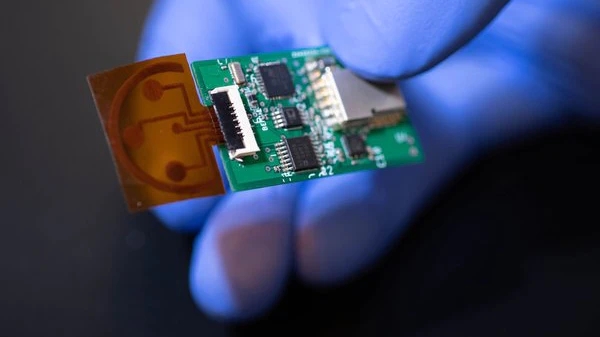
The sensor determines the stress level by accurately tracking, in near real-time, the levels of a natural compound called “cortisol” in sweat. Cortisol is believed to be the hormone that is released in the human body when stressed. According to Gao, the circadian pattern of cortisol in patients who for instance have PTSD or Depression is different from those in healthy individuals, as such, by identifying the cortisol patterns, the level of stress can be diagnosed and the speed at which the sensor does this means the 1+hours wait for blood tests and the associated stress-inducing blood sample draw can be avoided.
Made from Graphene, a sheet-like form of carbon, the new sensor uses a detection approach similar to that of another sweat sensor developed by Gao which is used in detecting the level of uric acid in the bloodstream so as to monitor cardiovascular diseases and other conditions like diabetes, and kidney-related diseases.
The new sensor features graphene combined with a plastic sheet that is etched with a laser to generate a 3D graphene structure, with tiny pores in which sweat can be analyzed. The pores, which create a large amount of surface area in the sensor, are coupled with antibodies that are immune to system molecules and sensitive to cortisol, aiding its detection.
Read more: CALTECH’S LOW-COST SWEAT SENSOR TRACKS STRESS THROUGH CORTISOL LEVELS
- What does the new sensor analyze to determine stress levels?
The sensor accurately tracks levels of the natural compound cortisol in sweat. - How does this sensor help patients with PTSD or Depression?
It identifies different circadian patterns of cortisol compared to healthy individuals to diagnose stress levels. - Can this sensor replace blood tests?
Yes, it avoids the one-plus-hour wait and the stress-inducing process of drawing blood samples. - What material is the sensor made from?
The sensor is made from graphene, which is a sheet-like form of carbon. - How are the pores created in the sensor?
A plastic sheet is etched with a laser to generate a 3D graphene structure containing tiny pores. - Do these pores increase the surface area of the sensor?
Yes, the pores create a large amount of surface area within the sensor. - How do antibodies aid in detection?
The pores are coupled with antibodies that are immune to system molecules but sensitive to cortisol. - Is this sensor wireless and invasive?
No, it is described as a wireless, non-invasive sensor. - Has this team developed similar sensors before?
Yes, they previously developed a sweat sensor using a similar approach to detect uric acid levels.
