
Summary of Beginning C for Arduino by Jack Purdum E-Book
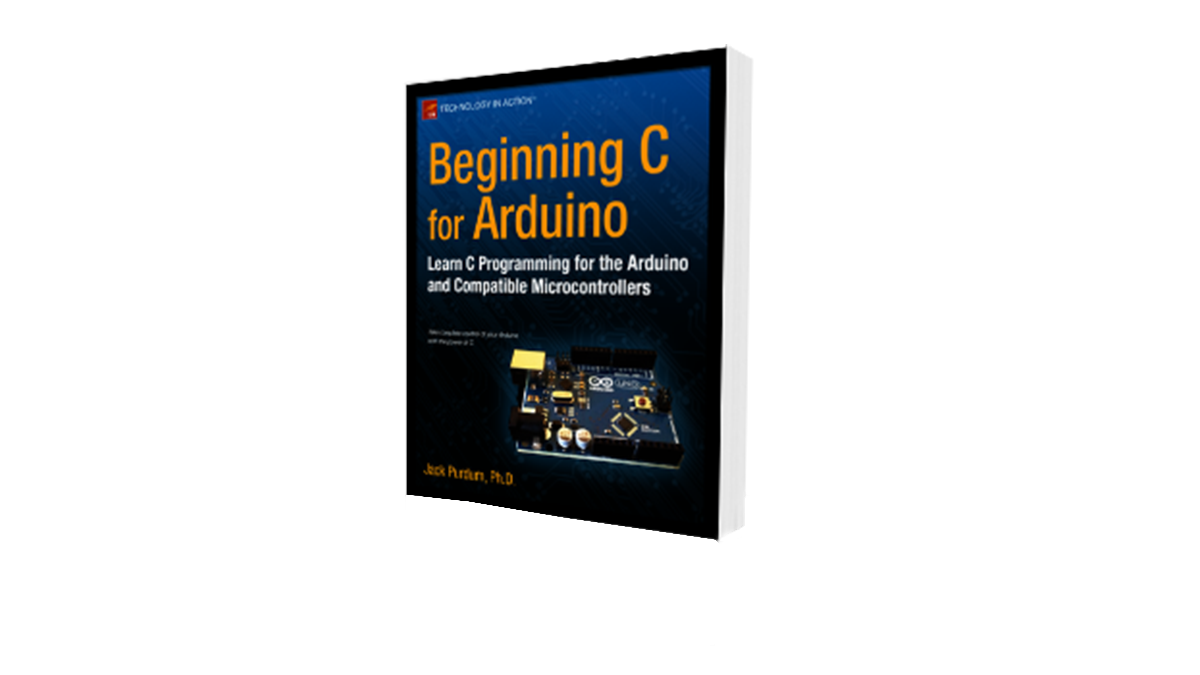
Beginning C for Arduino teaches C programming from scratch with practical Arduino microcontroller examples. Jack Purdum covers basic to advanced C topics—data types, control structures, functions, pointers, the preprocessor, I/O, and libraries—plus hardware integration and exercises to reinforce learning. Aimed at novices, it blends software and hardware instruction for building and extending Arduino projects.
Parts used in the Beginning C for Arduino:
- Arduino microcontroller (Arduino family)
- Low cost off-the-shelf hardware shields
- Standard hardware components (see Appendix B - Hardware Components)
- Suppliers for parts (see Appendix A - Suppliers)
Book Description
Beginning C for Arduino is written for those who have no prior experience with microcontrollers or programming but would like to experiment and learn both. This book introduces you to the C programming language, reinforcing each programming structure with a simple demonstration of how you can use C to control the Arduino family of microcontrollers. Author Jack Purdum uses an engaging style to teach good programming techniques using examples that have been honed during his 25 years of university teaching.
Beginning C for Arduino will teach you:
- The C programming language
- How to use C to control a microcontroller and related hardware
- How to extend C by creating your own library routines
During the course of the book, you will learn the basics of programming, such as working with data types, making decisions, and writing control loops. You’ll then progress onto some of the trickier aspects of C programming, such as using pointers effectively, working with the C preprocessor, and tackling file I/O. Each chapter ends with a series of exercises and review questions to test your knowledge and reinforce what you have learned.
What you’ll learn
- The syntax of the C programming language as defined for the Arduino
- Tried and true coding practices (applicable to any programming language)
- How to design, code, and debug programs that drive Arduino microcontrollers
- How to extend the functionality of C
- How to integrate low cost, off-the-shelf, hardware shields into your own projects
Who this book is for
The book is aimed at a complete novice with no programming background. It assumes no prior programming or hardware design experience and is written for creative and curious people who would like to blend a software and hardware learning experience into a single, enjoyable endeavor.
Table of Contents
- Introduction to Arduino Microcontrollers
- Arduino C
- Data Types
- Decision Making in C
- Program Loops
- Functions in C
- Storage Classes and Scope
- Introduction to Pointers
- Using Pointers Effectively
- I/O Operations
- The C Preprocessor
- Arduino Libraries
- Appendix A – Suppliers
- Appendix B – Hardware Components
Book Details |
|
| Publisher: | Apress |
| By: | Jack Purdum |
| ISBN: | 978-1-4302-4776-0 |
| Year: | 2012 |
| Pages: | 280 |
| Language: | English |
| File size: | 29 MB |
| File format: | |
Paper Book |
|
| Buy: | Beginning C for Arduino by Jack Purdum E-Book |
- Who is Beginning C for Arduino aimed at?
The book is aimed at complete novices with no programming or hardware design experience. - What programming language does the book teach?
The book teaches the C programming language as defined for the Arduino. - How does the book teach C concepts?
Each programming structure is reinforced with simple demonstrations controlling Arduino microcontrollers and exercises at the end of chapters. - Does the book cover hardware integration?
Yes, it explains how to integrate low cost off-the-shelf hardware shields into projects. - What advanced C topics are included?
The book covers pointers, the C preprocessor, storage classes and scope, and file I/O. - Are there practical exercises in the book?
Yes, each chapter ends with exercises and review questions to test knowledge. - Can I extend C functionality using the book?
Yes, the book shows how to extend C by creating your own library routines. - What supplementary information is provided?
Appendix A lists suppliers and Appendix B lists hardware components.
