
Summary of BAROMETRIC PRESSURE SENSOR FOR SMARTPHONES, WEARABLE AND HEARABLE DEVICES
Bosch Sensortec's BMP390 barometric pressure sensor delivers 50% better accuracy and can detect height changes under 10 cm, improving altitude tracking for smartphones, wearables, and hearables. Enhanced vertical positioning helps indoor localization—crucial for emergency caller floor-level identification—and pairs with services like NextNav's Metropolitan Beacon System for consistent z-axis accuracy. The BMP390 also improves indoor navigation when combined with sensors such as the Position Tracking Smart Sensor BHI160BP, compensating for GPS limitations in shielded environments.
Parts used in the BMP390 Pressure Sensor Project:
- Bosch Sensortec BMP390 barometric pressure sensor
- Position Tracking Smart Sensor BHI160BP
- NextNav Metropolitan Beacon System (MBS) z-axis service
- Smartphones (integration platform)
- Wearable devices (integration platform)
- Hearable devices (integration platform)
Bosch Sensortec has announced a barometric pressure sensor that is able to deliver much higher levels of accuracy for altitude tracking in smartphones as well as wearable and hearable devices.
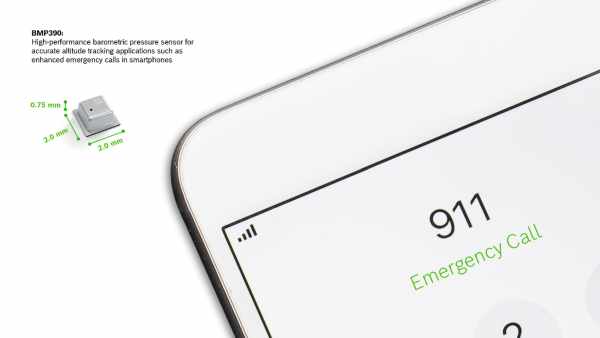
The sensor, the BMP390, can measure height changes below 10cms thanks to the improved resolution and is 50 percent more accurate than its predecessor.
Accurate altitude detection helps to localize people indoors, where GPS signals are not available. The addition of the vertical-specific position to existing horizontal information enables first responders to determine the floor level of smartphone users who trigger an emergency call.
The use of Bosch Sensortec’s latest BMP390 pressure sensor in smartphones, enables a high precision localization service that ultimately has the potential to save thousands of lives,” said Dr. Stefan Finkbeiner, CEO at Bosch Sensortec.
Wireless providers in the US will soon be required to meet an increasingly stringent series of location accuracy benchmarks, including providing the caller’s dispatchable location and similar moves could be implemented in other regions like Europe or Asia, to further improve people’s safety and peace of mind.
Bosch and NextNav, a 3D geolocation service provider, have collaborated on component specifications and system performance resulting in consistent, high accuracy z-axis capabilities indoors. This is accomplished by applying barometric pressure sensors in the phone, like the Bosch BMP390, and combining them with NextNav’s Metropolitan Beacon System (MBS) z-axis service to determine three-dimensional location and positioning.
The sensor also enables improved indoor navigation in general, for example in combination with the Position Tracking Smart Sensor BHI160BP. These solutions compensate for traditional localization technologies such as GPS that do not work efficiently in shielded environments.
Read more: BAROMETRIC PRESSURE SENSOR FOR SMARTPHONES, WEARABLE AND HEARABLE DEVICES
- What is the vertical resolution capability of the BMP390?
The BMP390 can measure height changes below 10 cms according to the article. - How much more accurate is the BMP390 compared to its predecessor?
It is 50 percent more accurate than its predecessor. - Can the BMP390 help with indoor localization where GPS is unavailable?
Yes, accurate altitude detection from the BMP390 helps localize people indoors where GPS signals are not available. - How does the BMP390 assist emergency responders?
By adding vertical-specific position information, it enables first responders to determine the floor level of smartphone users who trigger an emergency call. - With which service has Bosch collaborated to improve z-axis indoor accuracy?
Bosch collaborated with NextNav and its Metropolitan Beacon System z-axis service. - Can the BMP390 be combined with other sensors for improved navigation?
Yes, it can be combined with the Position Tracking Smart Sensor BHI160BP for improved indoor navigation. - What device types are targeted for the BMP390 integration?
The article mentions smartphones, wearable devices, and hearable devices. - Why are wireless providers focusing on location accuracy?
Wireless providers in the US will be required to meet stricter location accuracy benchmarks, including providing the caller's dispatchable location, to improve safety.
