
Summary of ARDUINO WIRE BENDER PROBABLY WON’T KILL ALL HUMANS
This article details an open-source, precision wire-bending machine designed by circuit sculptor Jiří Praus to create custom springs. The project utilizes an Arduino microcontroller paired with a CNC shield and two NEMA 17 stepper motors for feeding and bending operations. A key design feature is the use of commonly available hardware and 3D-printed parts that require no supports during printing, ensuring accessibility for DIY enthusiasts.
Parts used in the Open Source Wire-Bending Machine:
- Spare Arduino
- CNC shield
- NEMA 17 steppers (two units)
- Wire spool holder
- Rollers (two sets)
- 3D printed parts
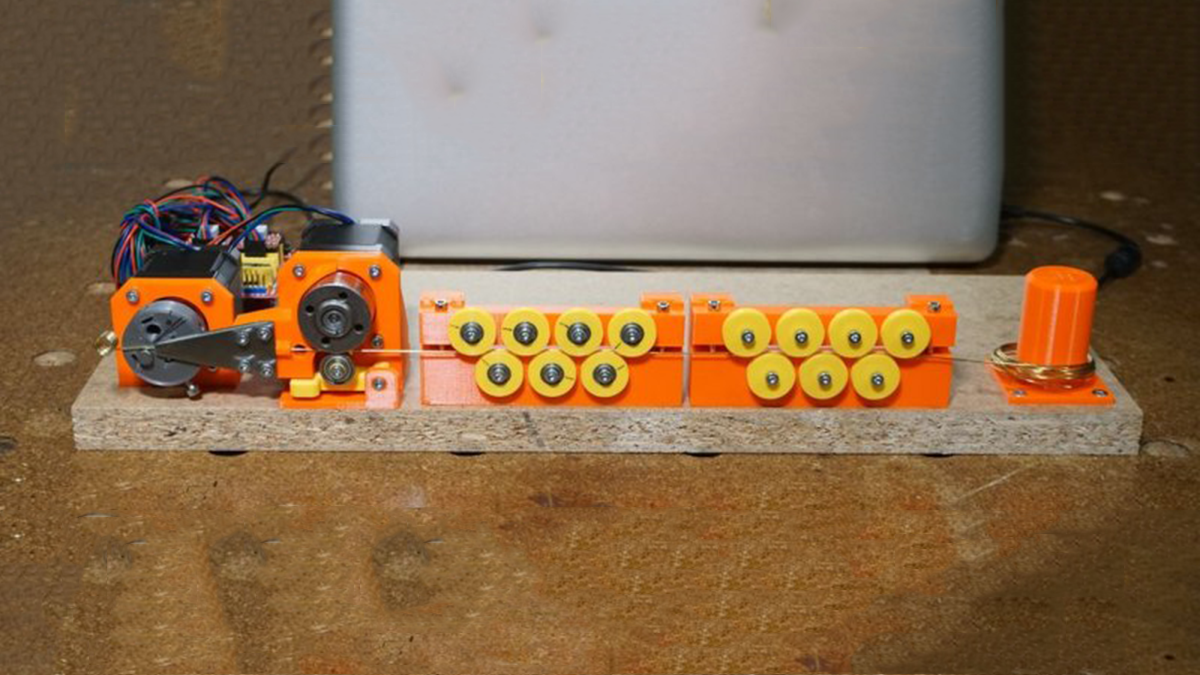
Do you want to make your own springs? Yeah, that’s what we thought. Well, blow the dust off of that spare Arduino and keep reading. A few months ago, we let you know that renowned circuit sculptor [Jiří Praus] was working on a precision wire-bending machine to help him hone his craft. Now it’s real, it’s spectacular, and it’s completely open source.
Along with that ‘duino you’ll need a CNC shield and a couple of NEMA 17 steppers — one to feed the wire and one to help bend it. Before being bent or coiled into springs, the wire must be super straight, so the wire coming off the spool holder runs through two sets of rollers before being fed into the bender.
[Jiří]’s main goal for this build was precision, which we can totally get behind. If you’re going to build a machine to do something for you, ideally, it should also do a better job than you alone. It’s his secondary goal that makes this build so extraordinary. [Jiří] wanted it to be easy to build with commonly-available hardware and a 3D printer. Every part is designed to be printed without supports. Bounce past the break to watch the build video.
Source: ARDUINO WIRE BENDER PROBABLY WON’T KILL ALL HUMANS
-
What is the main goal of this build?
The main goal was precision to ensure the machine does a better job than a person alone. -
How many NEMA 17 steppers are required?
Two NEMA 17 steppers are needed; one feeds the wire and the other helps bend it. -
Why must the wire be super straight before bending?
The wire runs through rollers to become super straight before being bent or coiled into springs. -
Can the parts be built without special tools?
Yes, every part is designed to be printed without supports using commonly-available hardware. -
Is the project open source?
Yes, the project is completely open source and described as spectacular. -
What secondary goal made this build extraordinary?
The secondary goal was making it easy to build with commonly-available hardware and a 3D printer.
