
Summary of ARDUINO LEARNS THE MARTIAL ARTS WITH NUNCHUCKS INPUT DEVICE
### Summary This article explores repurposing Nintendo Wii nunchucks as superior input devices for microcontroller projects. By connecting the nunchuck's I2C interface to an Arduino or similar board, users gain access to an analog joystick, two buttons, and an accelerometer. The author recommends using a custom breakout board for a robust connection rather than cutting wires directly. With available libraries and low-cost controllers, these devices are ideal for applications like Tetris games or motion-controlled gimbals.
Parts used in the Nunchuck Input Device Project:
- Nintendo Wii Nunchuck
- Wii Controller (for connection)
- I2C Interface
- Arduino or small microcontroller
- Breakout board (custom design from OSHPark)
- Solder points
- Cable
- Available library for reading data
There is a boring part of every computer introduction class that shows how a computer is made up of input, output, and processing. Maybe it wouldn’t be so boring if the input device was a nunchuck. [Brian Lough] thinks so and he belligerently asserts that nunchucks are the best input device ever. With a simple connection to a Wii controller and an associated library, you get access to an analog joystick, two buttons, and an accelerometer.
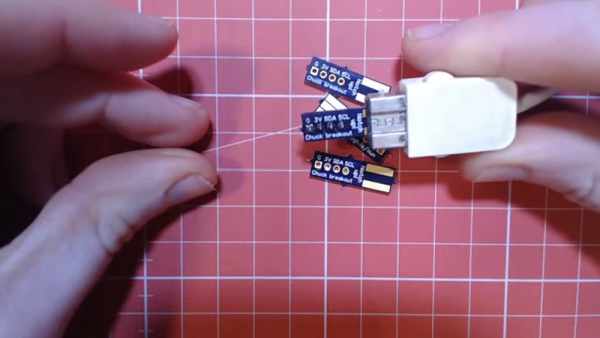
The nunchuck is meant to plug into a Wii controller and the connection is I2C, so that’s trivial to interface to an Arduino or other small microcontroller. The only issue is making the connection. We might have just snipped the wires, but [Brian] prefers to use a small breakout board that plugs into the stock connector and provides solder points for your own cable. There are options for the breakout boards, and [Brian] has his own design that you can get from OSHPark for about a buck for three boards. You can also just jam wire into the connector, but that’s not always robust.
The controllers use 3.3V which isn’t unusual these days. There’s an available library that makes reading them easy. Obviously, not all applications will be a natural fit, but we did like them on the Tetris game [Brian] created. It is also natural for any kind of motion control like his gimbal mount example.
Even if you don’t have junk Wii controllers hanging around, they are common enough on the resale market and you can buy new third-party controllers without spending much. Makes us sorry we threw away ours in the last move.
If you want to get serious hacking a nunchuck, you can go full custom. Or, just give up, and turn one into a Raspberry Pi.
Source: ARDUINO LEARNS THE MARTIAL ARTS WITH NUNCHUCKS INPUT DEVICE
- What components does a nunchuck provide when connected?
It provides access to an analog joystick, two buttons, and an accelerometer. - How does the nunchuck connect to a microcontroller?
The connection uses the I2C protocol which is trivial to interface with an Arduino. - What is the recommended method for making the physical connection?
The author prefers using a small breakout board that plugs into the stock connector instead of snipping wires. - Can you buy nunchucks if you do not have old ones?
Yes, they are common on the resale market or available as new third-party controllers for little cost. - What voltage do the controllers use?
The controllers operate at 3.3V. - Are there specific applications where nunchucks work well?
They are natural fits for motion control like gimbal mounts and games such as Tetris. - Where can you obtain the custom breakout board mentioned?
The custom design is available from OSHPark for about a buck for three boards. - Is it possible to hack a nunchuck for full customization?
Yes, you can go full custom or even turn one into a Raspberry Pi.
