
Summary of ANAVI Miracle Controller open source Wi-Fi development board
The ANAVI Miracle Controller is an open-source ESP8266-based Wi-Fi board by Anavi Technology, designed to control two 5V or 12V addressable LED strips simultaneously. Priced from $25 with shipping expected in April 2020, it integrates a mini OLED display and supports multiple I²C sensors for light, temperature, humidity, pressure, and gesture detection. Fully compatible with Arduino IDE, PlatformIO, Home Assistant, and OpenHAB via MQTT, it serves developers and makers seeking robust home automation solutions.
Parts used in the ANAVI Miracle Controller:
- Tensilica L106 32-bit processor (ESP8266)
- Wi-Fi 802.11 b/g/n module
- Mini OLED I²C display
- BH1750 I²C light sensor
- BMP180 I²C temperature and barometric pressure sensor
- APDS-9960 I²C RGB color and gesture detection sensor
- HTU21D I²C temperature and humidity sensor
- UART pins
- GPIO pin for external peripherals
- Button
- Three slots for additional I²C sensor modules
An ESP8266 powered Wi-Fi development board is available via Crowd Supply offering an easy way to control two 5V or 12v LED strips. The ANAVI Miracle Controller has been created by the team at Anavi Technology and is priced from $25 with worldwide shipping available and fulfilment expected to take place during April 2020.
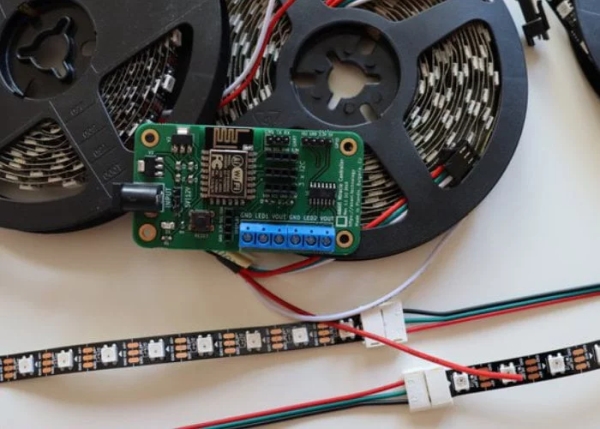
Out of the box, ANAVI Miracle Controller supports the following sensors and peripherals. 0.96″ OLED I²C display, BH1750 I²C sensor for light, BMP180 I²C sensor for temperature and barometric pressure, APDS-9960 I²C sensor for RGB color and gesture detection and HTU21D I²C temperature and humidity sensor.
ANAVI Miracle Controller is an open source hardware Wi-Fi development board powered by the ESP8266 and designed to control two 5 V and 12 V addressable LED strips simultaneously. It supports popular LEDs including Neopixel, WS2811, WS2812B, TM1809, etc. It also has a dedicated slot for a mini OLED I²C display and slots for up to three additional I²C sensor modules. Furthermore, there are UART pins for easy flashing of custom software and an extra GPIO for connecting external peripherals. All these features make ANAVI Miracle Controller appropriate for developers, makers, students, and open source enthusiasts interested in home automation.”
ANAVI Miracle Controller is fully compliant with Arduino IDE, PlatformIO, the popular open source home automation software tools, as well as with Home Assistant and OpenHAB via the lightweight messaging protocol MQTT. With ANAVI Miracle Controller, developers can focus on the software by easily building and flashing their own versions of the source code. Tech savvy users can easily integrate ANAVI Miracle Controller in their existing open source home automation platforms.”
Specifications of the ANAVI Miracle Controller :
– Microcontroller: Tensilica L106 32-bit processor (ESP8266)
– Wireless: Wi-Fi 802.11 b/g/n
– Voltage Connectivity: Simultaneous support for two 5 V or 12 V addressable LED strips
– LED Compatibility: Open source Arduino sketch with FastLED library will support various strips strips: WS2812, WS2812B, WS2811, TM1804, etc.
– Peripheral Support: Mini OLED display, UART pins, button, three slots for I²C sensors
– Software Compatibility: Arduino IDE, PlatformIO, Home Assistant, OpenHAB 2, MQTT, and any modern web browser
– Open Source Certification: Open Source Hardware Association (OSHWA) BG000050
– Dimensions: 75 mm x 40 mm
Source: ANAVI Miracle Controller open source Wi-Fi development board
- What is the ANAVI Miracle Controller?
An open source hardware Wi-Fi development board powered by the ESP8266 designed to control two 5 V and 12 V addressable LED strips. - Can the board support multiple types of LED strips?
Yes, it supports popular LEDs including Neopixel, WS2811, WS2812B, TM1809, and others via the FastLED library. - Does the controller include built-in sensors?
Yes, it includes slots for a mini OLED display and up to three I²C sensors such as BH1750, BMP180, APDS-9960, and HTU21D. - How can users flash custom software on the device?
Users can utilize the dedicated UART pins for easy flashing of custom software. - Is the ANAVI Miracle Controller compatible with Home Assistant?
Yes, it is fully compliant with Home Assistant and OpenHAB via the lightweight messaging protocol MQTT. - What programming environments are supported?
The board is fully compliant with Arduino IDE and PlatformIO. - What are the dimensions of the development board?
The dimensions are 75 mm x 40 mm. - When was fulfillment expected for orders?
Fulfillment was expected to take place during April 2020.
