
Summary of A NO-CALIBRATION METAL DETECTOR
This article describes a modern metal detector project that combines a single transistor oscillator with an Arduino microcontroller. Unlike traditional designs requiring two oscillators and manual calibration, this setup uses the Arduino as a frequency counter to detect changes caused by metal, eliminating the need for calibration steps while maintaining simplicity.
Parts used in the Metal Detector:
- Single transistor
- Oscillator circuit
- Arduino microcontroller
- Large search coil
- Tuned circuit components
A traditional early project for someone discovering a love for electronics has been for many years a metal detector. This would mean a few transistors back in the day, but today it’s more likely to involve a microcontroller. [Mircemk] has an example that bends both worlds, with a single transistor oscillator and an Arduino.
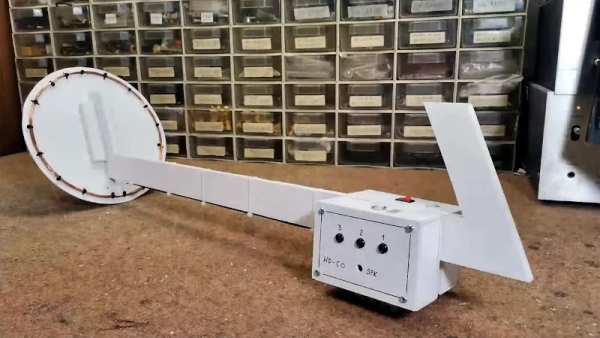
This type of metal detector has a large search coil which forms part of the tuned circuit in an oscillator. As a piece of metal enters its range the frequency of oscillation changes. In the old days, this would have been detected as an audible beat frequency with another oscillator. This design would require a calibration step at the start of detecting, to tune the two oscillators to the same frequency.
This detector keeps the first oscillator but eschews the second one in favor of an Arduino. The microcontroller acts as a frequency counter, monitoring the frequency and issuing an alarm when it detects a change likely to be caused by a piece of metal. It may not have some of the finess a human ear could apply to a beat frequency in the all-analogue days, but it’s simple enough to build and it avoids the need for calibration. Seeing it in the video below the break we’re sure that just like those transistor models old, there will be plenty of fun to be had with it.
An Arduino may be one of the current go-to parts, but will it ever displace the 555? Perhaps not in the world of metal detectors!
Source: A NO-CALIBRATION METAL DETECTOR
-
How does the search coil function in this design?
The large search coil forms part of the tuned circuit in an oscillator where frequency changes when metal enters its range. -
Does this project require a calibration step?
No, the design avoids the need for calibration by using the Arduino to monitor frequency changes directly. -
What role does the Arduino play in this circuit?
The microcontroller acts as a frequency counter that monitors the signal and issues an alarm upon detecting a change likely caused by metal. -
How does this design differ from old analogue metal detectors?
Older models used two oscillators to create an audible beat frequency, whereas this design uses one oscillator and an Arduino instead. -
Will the 555 timer ever replace the Arduino in metal detectors?
The article suggests the 555 may not be displaced in the world of metal detectors despite the popularity of the Arduino. -
What is the primary advantage of using an Arduino over a second oscillator?
Using an Arduino simplifies the build process and removes the requirement for tuning two oscillators to the same frequency.
