
Summary of A DEEP DIVE INTO A 1980S RADIO SHACK COMPUTER TRAINER
The article revisits Radio Shack’s Science Fair Microcomputer Trainer, a 1980s educational kit centered on a TMS1100 4-bit microcontroller. It describes the kit’s cardboard breadboard, spring terminals, LEDs, seven-segment display, speaker, keyboard, and 400 kHz clock. Michael Wessel’s videos show basic programs, oscilloscope measurements (~400 instructions/sec), and an 80-nibble Tower of Hanoi demo that runs in user-stepped spurts. The piece suggests renewed interest and encourages collectors to consider acquiring one.
Parts used in the Science Fair Microcomputer Trainer:
- Texas Instruments TMS1100 4-bit microcontroller
- 400 kHz crystal oscillator
- Light-emitting diodes (LEDs)
- Seven-segment display
- Speaker
- Rudimentary keyboard (keypad)
- Colorful cardboard breadboard with spring terminals
- Jumper wires
- On-board ROM and RAM (part of TMS1100)
For those of us who remember Radio Shack as more than just an overpriced cell phone store, a lot of the nostalgia for the retailer boils down to the brands on offer. Remember the Realistic line of hi-fi and stereo gear? How about Archer brand tools and parts? Patrolman scanners, Micronta test instruments, and don’t forget those amazing Optimus speakers — all had a place in our development as electronics nerds.
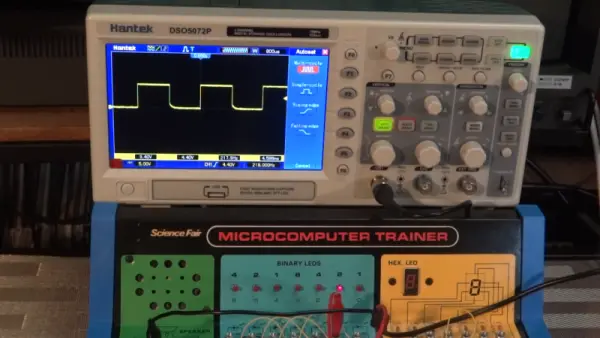
But perhaps the most formative brand under the Radio Shack umbrella was Science Fair, with a line of kits and projects that were STEM before STEM was a thing. One product that came along a little too late for our development was the Science Fair Microcomputer Trainer, and judging by [Michael Wessel]’s deep dive into the kit, we really missed the boat. The trainer was similar to the earlier “100-in-1”-style breadboarding kits, with components laid out on a colorful cardboard surface and spring terminals connected to their leads, making it easy to build circuits using jumper wires. The star of the show in the microcomputer trainer was a Texas Instruments TMS1100, which was a pretty advanced chip with a 4-bit CPU with its own ROM and RAM as well as a bunch of IO lines. The trainer also sported a peppy little 400-kHz crystal oscillator clock, a bunch of LEDs, a seven-segment display, a speaker, and a rudimentary keyboard.
The first video below is a general introduction to the trainer and a look at some basic (not BASIC) programs. [Michael] also pulls out the oscilloscope to make some rough measurements of the speed of the TMS1100, which turns out to be doing only about 400 instructions per second. That’s not much, but in the second video we see that it was enough for him to nerd-snipe his collaborator [Jason] into coding up an 80-nibble Tower of Hanoi solver. It’s a little awkward to use, as the program runs in spurts between which the user needs to check memory locations to see which disc to move to which peg, but it works.
It looks like people are rediscovering the Microcomputer Trainer all of a sudden. It might be a good time to pick one up.
Source: A DEEP DIVE INTO A 1980S RADIO SHACK COMPUTER TRAINER
- What microcontroller does the trainer use?
The trainer uses a Texas Instruments TMS1100 4-bit microcontroller. - How is the circuit construction implemented on the trainer?
Components are laid out on a colorful cardboard surface with spring terminals for connections using jumper wires. - What clock frequency does the trainer use?
The trainer uses a 400 kHz crystal oscillator clock. - How fast does the TMS1100 run in the trainer?
Oscilloscope measurements show it performs about 400 instructions per second. - What output and input peripherals are included?
The kit includes LEDs, a seven-segment display, a speaker, and a rudimentary keyboard. - Can the trainer run complex demonstrations?
Yes; an example is an 80-nibble Tower of Hanoi solver that runs in spurts with user-stepped memory checks. - Does the TMS1100 include memory on-chip?
Yes; the TMS1100 has its own ROM and RAM as part of the chip. - Are people showing renewed interest in the Microcomputer Trainer?
Yes; the article notes people are rediscovering the trainer and suggests it might be a good time to pick one up.
