
Summary of TWO-CHANNEL GUITAR STOMP BOX MAKES MOMENTARY SWITCHES LATCHING
This article explains a guitar effects pedal project by Maarten Tromp that uses momentary switches to control latching behavior via an ATtiny2313 microcontroller. Instead of direct switching, the code interprets tap duration: short taps latch the effect on/off, while long presses hold it active only while pressed. This design offers flexibility over 555 timers and allows easy expansion for multi-channel setups in musical performances.
Parts used in the Two-Channel Guitar Stomp Box:
- Momentary push-button switches
- ATtiny2313 microcontroller
- Relay
- Tube-amp tremolo (mentioned as related project)
- Arduino Mega multipedal (mentioned as related project)
- Digital delay line (mentioned as related project)
When we first saw [Maarten Tromp]’s article about a “momentary latching switch” for guitar effects pedals, we have to admit to being a bit confused. When it comes to push-button switches, “momentary” and “latching” seem to be at odds with each other, with different mechanisms inside the switch to turn one into the other. What gives?
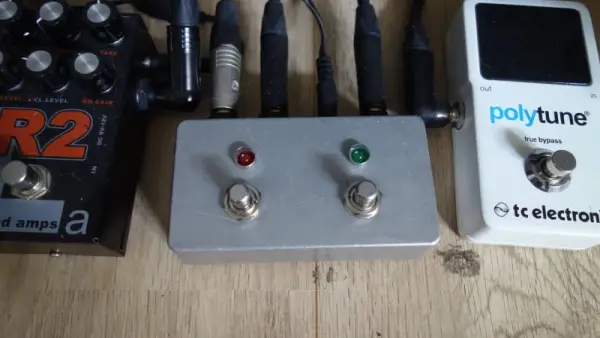
As it turns out, [Maarten]’s build makes perfect sense when you consider the demands of a musical performance. Guitar effects pedals, or “stomp boxes,” are often added to the output of electric guitars and other instruments to change the signals in some musically interesting way. The trouble is, sometimes you only need an effect for a few bars, and the push-on, push-off switches on many effects pedals make that awkward.
[Maarten]’s idea was to build a stomp box with momentary switches that act as inputs to an ATtiny2313 microcontroller rather than directly controlling the effect. That way, a bit of code can determine how long the switch is tapped, and activate a relay to do the actual switching accordingly. A short tap of the button tells the microcontroller to latch the relay closed until another tap comes along; a long press means that the relay is held open only as long as the button is held down.Yes, he could have used a 555, a fact which [Maarten] readily acknowledges, but with some loss of flexibility; he currently has the threshold set at 250 milliseconds, which works for his performance style. Changing it would be a snap in code, as would toggling the latching logic. A microcontroller also makes expansion from the two-channel setup shown here easier.
Looking for more effects pedal action? We’ve got a bunch — a tube-amp tremolo, an Arduino Mega multipedal, a digital delay line. Take your pick!
Source: TWO-CHANNEL GUITAR STOMP BOX MAKES MOMENTARY SWITCHES LATCHING
- Why use momentary switches instead of standard latching ones?
Momentary switches allow the microcontroller to determine how long the button is tapped to activate a relay, solving the awkwardness of push-on push-off switches for short musical bars. - How does the system distinguish between a short tap and a long press?
The microcontroller code checks the threshold set at 250 milliseconds; a short tap latches the relay, while a long press holds it open only while the button is down. - What component controls the actual switching mechanism?
A relay is activated by the microcontroller code to perform the actual switching based on input from the momentary switches. - Can the time threshold for distinguishing taps be changed easily?
Yes, changing the threshold would be a snap in code compared to hardware adjustments required with other components like a 555 timer. - Why did the builder choose a microcontroller over a 555 timer?
A microcontroller provides more flexibility and makes expanding the setup from two channels easier than using a 555 timer. - What happens if you hold the button down for a long time?
A long press means the relay is held open only as long as the button is held down, rather than latching. - Is this design suitable for live musical performance?
Yes, the design addresses specific demands of musical performance where effects are needed for varying durations. - Are there other related effects pedal projects mentioned?
Yes, the article mentions a tube-amp tremolo, an Arduino Mega multipedal, and a digital delay line as other options.
