
Summary of MONITORING WATER QUALITY USING LOTS OF SENSORS AND MACHINE LEARNING
Over a billion people lack clean water, prompting [kutluhan_aktar] to build a portable, internet-connected pollution monitor. The device uses five sensors to measure oxidation-reduction potential, pH, total dissolved solids, turbidity, and temperature. A neural network trained on local data processes these inputs via the Neuton framework on an Arduino MKR GSM 1400 module, outputting a simple quality indicator. Data is transmitted via GSM/3G to a central database from within a custom 3D-printed enclosure to help locate pollution sources.
Parts used in the Portable Water Pollution Monitor:
- Five different sensors (oxidation-reduction potential, pH, total dissolved solids, turbidity, and temperature)
- Arduino MKR GSM 1400 module
- Neuton framework software platform
- GSM/3G modem
- 3D-printed enclosure
Despite great progress over the past century, more than a billion people still don’t have access to clean drinking water today. Much of the water on Earth’s surface is polluted, but it’s not always easy to tell a dirty stream from a clean one. Professional kit for water analysis can be expensive, which is why [kutluhan_aktar] decided to design a portable, internet-connected water pollution monitor.
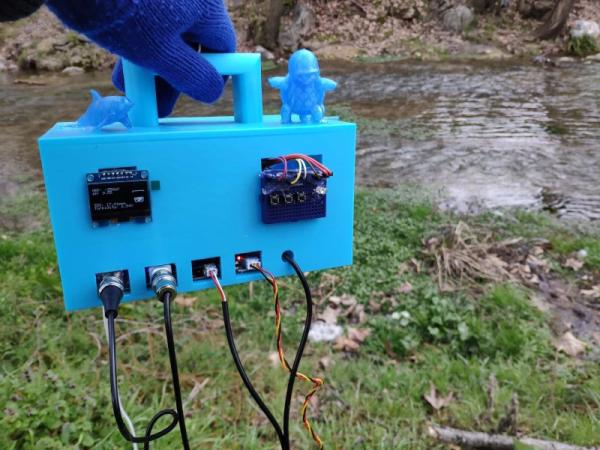
There is no single parameter that determines the quality of a water sample, so the pollution monitor has no less than five different sensors. These can determine the oxidation-reduction potential (a chemical indicator), the pH (acidity), total dissolved solids (mainly salts), turbidity (suspended particles) and temperature. To combine all these numbers into a simple “yes/maybe/no” indicator, [kutluhan] trained a neural network with data gathered from a large number of places around his hometown.
This neural network runs on an Arduino MKR GSM 1400 module. While not a typical platform for AI applications, the neural network runs just fine on it thanks to the Neuton framework, a software plaform designed to run machine learning applications on microcontroller systems like the Arduino. It also has a GSM/3G modem, allowing it to report the measured water quality to a central database.
All of this is housed in a 3D-printed enclosure that makes the whole setup easy to carry and operate in any location. Collecting data across a wide area should help to locate sources of pollution, and hopefully contribute to an improvement in water quality for everyone. Here at Hackaday we love citizen science initiatives like this: previously we’ve featured projects to measure things as varied as air quality and ocean waves.
Source: MONITORING WATER QUALITY USING LOTS OF SENSORS AND MACHINE LEARNING
- Why did the creator design this specific monitor?
Professional water analysis kits are expensive, so a portable, internet-connected solution was needed. - How many sensors does the device use?
The monitor utilizes no less than five different sensors to determine water quality. - What parameters do the sensors measure?
They measure oxidation-reduction potential, pH, total dissolved solids, turbidity, and temperature. - How does the device simplify complex sensor data?
A neural network trained on local data converts the readings into a simple yes/maybe/no indicator. - Which hardware runs the neural network application?
The neural network runs on an Arduino MKR GSM 1400 module. - What software allows machine learning on this microcontroller?
The Neuton framework is designed to run machine learning applications on systems like the Arduino. - How is the collected data transmitted to a central location?
The built-in GSM/3G modem reports measured water quality to a central database. - What material houses the electronic components?
All components are housed in a 3D-printed enclosure for portability.
