
Summary of WHEN HACKING AND BIOSENSING COLLIDE
This article highlights Prof. Edwin Hwu's work on repurposing consumer electronics for biosensing and nano-scale printing. He demonstrates how Blu-ray disc read-write heads and optical pickups can be used to build affordable atomic force microscopes (AFMs) and high-speed microscopy strobes. The project also involves piezo discs for AFM construction and utilizing DVD players for microfluidics. Additionally, the lab employs Blu-ray drives in 3D printing processes to expose photopolymers and spin-coat discs with media, showcasing innovative, low-cost scientific hacking techniques.
Parts used in Consumer Electronics Biosensing Project:
- Blu-ray disc unit read-write head
- Optical pickup from Blu-ray drive
- Piezo discs
- DVD player
- Wireless spy camera pen
- Photopolymer
- Spin-coating medium
[Prof. Edwin Hwu] of the Technical University of Denmark wrote in with a call for contributions to special edition of the open-access scientific journal Biosensors. Along the way, he linked in videos from three talks that he’s given on hacking consumer electronics gear for biosensing and nano-scale printing. Many of them focus on clever uses of the read-write head from a Blu-ray disc unit (but that’s not all!) and there are many good hacks here.
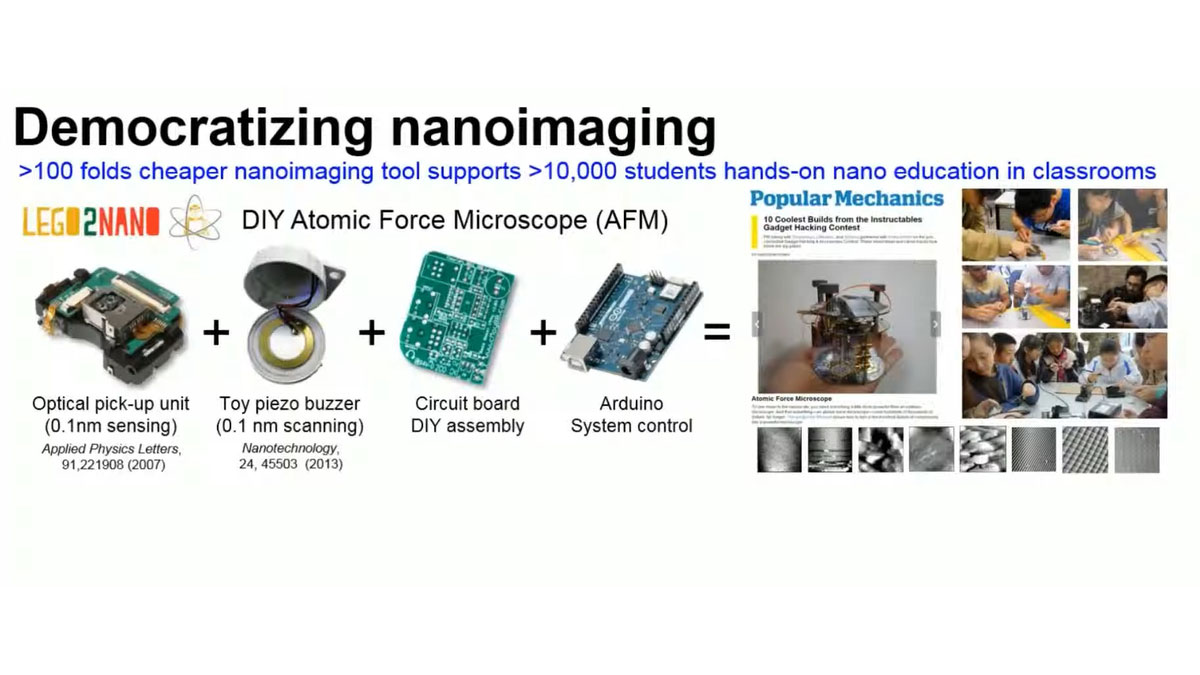
For instance, this video on using the optical pickup for the optics in an atomic force microscope (AFM) is bonkers. An AFM resolves features on the sub-micrometer level by putting a very sharp, very tiny probe on the end of a vibrating arm and scanning it over the surface in question. Deflections in the arm are measured by reflecting light off of it and measuring their variation, and that’s exactly what these optical pickups are designed to do. In addition to phenomenal resolution, [Dr. Hwu’s] AFM can be made on a shoestring budget!
Speaking of AFMs, check out his version that’s based on simple piezo discs in this video, but don’t neglect the rest of the hacks either. This one is a talk aimed at introducing scientists to consumer electronics hacking, so you’ll absolutely find yourself nodding your heads during the first few minutes. But then he documents turning a DVD player into a micro-strobe for high speed microfluidics microscopy using a wireless “spy camera” pen. And finally, [Dr. Hwu’s] lab has also done some really interesting work into nano-scale 3D printing, documented in this video, again using the humble Blu-ray drive, both for exposing the photopolymer and for spin-coating the disc with medium. Very clever!
If you’re doing any biosensing science hacking, be sure to let [Dr. Hwu] know. Or just tear into that Blu-ray drive that’s collecting dust in your closet.
Source: WHEN HACKING AND BIOSENSING COLLIDE
- How does an atomic force microscope resolve features?
An AFM resolves sub-micrometer level features by scanning a sharp probe on a vibrating arm over a surface and measuring deflections via light reflection. - Can you make an atomic force microscope on a budget?
Yes, Dr. Hwu’s AFM can be constructed using optical pickups from Blu-ray drives for phenomenal resolution at a low cost. - What is used to create the simple version of the AFM?
The simple version of the AFM is based on simple piezo discs. - How is a DVD player utilized in this project?
A DVD player is turned into a micro-strobe for high speed microfluidics microscopy. - What component helps achieve high speed microfluidics microscopy?
A wireless spy camera pen is used alongside the modified DVD player for high speed microfluidics microscopy. - How are Blu-ray drives used in nano-scale 3D printing?
The Blu-ray drive is used both for exposing the photopolymer and for spin-coating the disc with medium. - What kind of journal did Prof. Edwin Hwu write to for contributions?
He wrote to the open-access scientific journal Biosensors for a special edition call for contributions. - What specific part of the Blu-ray unit focuses on clever uses?
The read-write head from a Blu-ray disc unit is highlighted for its clever uses in these hacks.
