
Summary of KINETIC STRIKES VIA A CONSUMER GRADE DRONE
This article details a project by [i did a thing] that adapts consumer drone technology to deploy kinetic projectiles. The creator machined steel darts and attached fins, mounting them on a DJI Mavic 2. A remote drop mechanism was engineered using an Arduino Uno and a light sensor to trigger a servo-controlled hook when the drone's lights activate. While intended for high-altitude drops to reach terminal velocity, safety concerns limited testing to 100 meters. Despite this, the 200-gram slugs successfully penetrated a car roof, demonstrating the lethal potential of such simple payloads.
Parts used in the Kinetic Strikes via Consumer Grade Drone:
- Lathe
- 1045 steel
- Fins (sourced from local hardware store)
- DJI Mavic 2 drone
- Arduino Uno
- Light sensor
- Servo motor
- Hook latch
- Hardened steel dart
Kinetic projectiles are a seldom-used weapon of war, consisting of heavy metal slugs dropped from a great height by aircraft. On the way down to the ground, they pick up enough speed to kill enemy troops and even penetrate light armor. [i did a thing] tried to replicate this simple technology using a consumer drone.
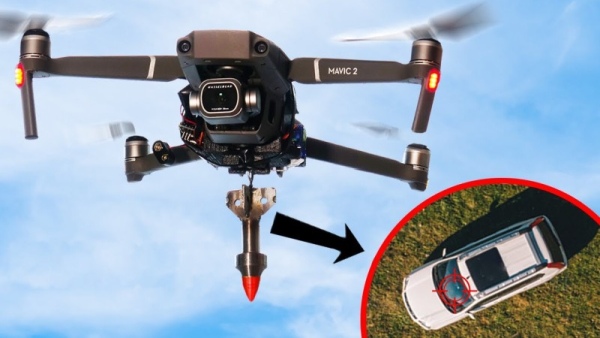
The kinetic projectiles were made on a lathe, using 1045 steel as a good balance between hardness and machinability. Simple mild steel is far too easy to blunt, while tool steel was beyond the machining capability of the tools on hand. Simple fins were added using materials sourced from the local hardware store.
The build relied on a DJI Mavic 2 drone, which has lights on the bottom that can be turned on and off remotely. Thus, for a quick and easy remote-drop system, [i did a thing] hooked up an Arduino Uno to monitor those lights using a simple light sensor. When the Arduino detects the lights switching on, it moves a servo which unlatches a hook holding the hardened steel dart beneath the drone.
Ideally, the dart would be dropped from an altitude of 600 meters, allowing it to reach its terminal velocity of around 432 km/h. However, in testing, the darts were highly inaccurate, which made drop tests unsafe beyond around 100 meters high.
However, even from this lower altitude, the 200 gram metal slugs were able to penetrate the roof of a Holden Commodore automobile, becoming embedded in the floor of the vehicle. Such testing is incredibly dangerous; had the projectiles hit a human, injuries could have been serious or even fatal.
Regardless, it serves to show just how easy it is to drop a payload from a modern remote-control drone. We’ve seen similar projects before, done with some elegant finesse. Video after the break.
Source: KINETIC STRIKES VIA A CONSUMER GRADE DRONE
- Why was 1045 steel chosen for the projectiles?
It offers a good balance between hardness and machinability compared to mild steel which is too soft or tool steel which was too difficult to machine. - How does the remote drop system work?
An Arduino Uno monitors the drone's bottom lights with a sensor; when they switch on, it triggers a servo to unlatch a hook holding the projectile. - What is the target altitude for reaching terminal velocity?
The ideal drop altitude is 600 meters to allow the dart to reach a terminal velocity of around 432 km/h. - Why were drop tests limited to 100 meters?
The darts proved highly inaccurate at higher altitudes, making drop tests beyond 100 meters unsafe. - What material was used to create the fins?
Simple fins were added using materials sourced from the local hardware store. - What happened during the penetration test on the car?
The 200 gram metal slugs penetrated the roof of a Holden Commodore automobile and became embedded in the floor. - Can the drone lights be controlled remotely?
Yes, the DJI Mavic 2 has lights on the bottom that can be turned on and off remotely. - What are the risks associated with these projectiles?
If the projectiles hit a human, injuries could have been serious or even fatal.
